What is NeonRoof building with NeonSwap and NADIUM?
NeonRoof is developing a shared gaming ecosystem where participating developers could accept NADIUM as game currency, recognize approved items from other games, and allow eligible digital game licenses to be resold. NeonSwap is the wallet and planned exchange interface connecting that vision to NeonRoof and Neonadium.
The important word is participating. Each studio would decide which currency uses, items and license transfers its game supports. A blockchain record can identify a token or item, but a game still needs an integration that gives that record meaning inside its world.
We want to make those connections useful to players without taking control of a developer's game economy. This article explains the direction, the practical limits, and the work that still has to happen.
What can you use today, and what is still planned?
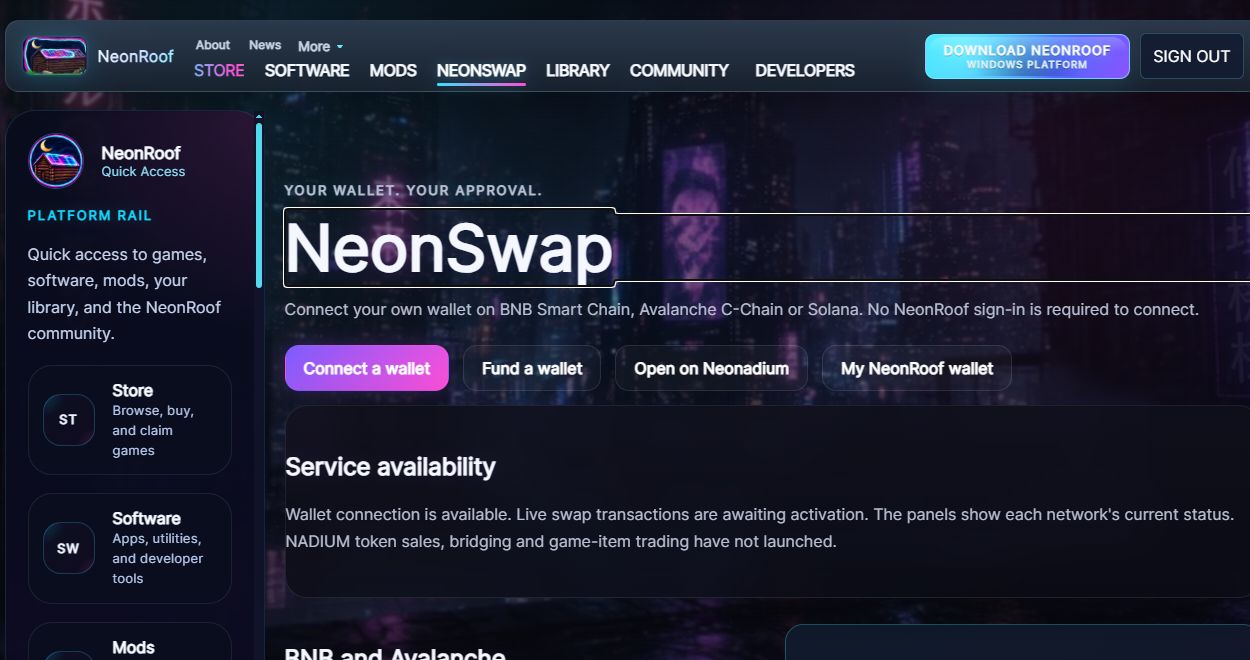
As of October 13, 2026, NeonSwap on NeonRoof offers external wallet connections for BNB Smart Chain, Avalanche C-Chain and Solana. It also presents wallet-funding options, with supported assets, payment methods and eligibility determined by the provider. Connecting an outside wallet does not require a NeonRoof account or authorize a payment.
Live swap transactions are awaiting activation. NADIUM mainnet token deployment, public sales and bridging have not launched. Cross-game item trading, NADIUM spending inside games and the used-game marketplace are also planned features. Testnet bridge preparation is underway, but successful transfers across all three test networks have not yet been demonstrated.
The interactive ecosystem demo is available now. Its Neon Dungeon and Neon Arena scenarios simulate a player moving through a shared inventory and item exchange. They are fictional demonstration environments, not released games or announced studio partnerships. Demo rewards and balances are not real NADIUM.
Players can explore the interfaces today. Developers can study the proposed integration model. Neither activity means a live token market or transferable game inventory is already available.
NADIUM as an in-game currency across participating games
Neonadium, with the planned ticker NADIUM, is being developed for use in the NeonRoof ecosystem. Its intended uses include eligible platform purchases and, later, currency and item transactions in games whose developers integrate it.
Think of a shared wallet balance that participating games can accept under their own rules. A player could spend some NADIUM on a cosmetic in one game and use the remaining balance in another participating game. The second game would not need to import the first game's entire character, quest history or economy.
That is a design goal, not a current service. Ordinary gold, credits or coins stored in an unrelated game's database would not automatically become NADIUM. A developer would need to authorize any earning, spending or conversion system and explain it to players.
Studios would also need to protect their economies. A reward that is easy to earn in one game must not become an unlimited source of purchasing power in another. Supply controls, spending limits, reward verification and clear pricing are part of making a shared currency workable.
Can items move from one game to another?
The proposed approach is developer-approved item mapping. A destination game would recognize an eligible shared item record and decide what it becomes locally.
For example, NeonRoof's simulated demo maps a fantasy weapon into equipment suited to a science-fiction setting. The useful connection is the approved ownership record and mapping. The destination studio supplies its own art, animations, item statistics and balance rules.
A practical integration could support several kinds of portability:
- A cosmetic earned in one participating game could unlock a related cosmetic in another.
- An approved collectible could be displayed across participating inventories.
- A resource could be exchanged for a destination game's permitted item under a published conversion rule.
- A developer-approved item could be listed for resale if its license and marketplace rules allow it.
These are possible designs, not a promise that every listed NeonRoof game will support them. A sword does not acquire working animations, collision behavior and combat statistics in another engine simply because someone puts its identifier on a blockchain.
Standards such as ERC-1155 provide a common contract interface for multiple token types, including fungible and non-fungible items. They can help with recording and transferring assets. They do not define how a game must render, equip or balance an item. That work belongs to the participating developer.
Reselling digital games when developers allow it
NeonRoof's used digital game marketplace roadmap proposes player-to-player transfers of eligible game licenses. Participation would be enabled by a game's developer or authorized publisher, with the applicable rules shown before a transaction.
The proposed flow is straightforward: verify that the seller owns an eligible license, check the title's transfer rules, confirm the buyer's payment, and move the entitlement from the seller's NeonRoof library to the buyer's. The seller would no longer retain that active library entitlement after a completed transfer.
Developers could define permitted resale conditions, such as a waiting period, minimum listing price or disclosed royalty. Buyer terms would need to explain fees, supported regions and what happens if a transaction fails. Payment and entitlement updates need to stay consistent so a license cannot be sold twice.
This would be a developer-approved NeonRoof feature. It would not turn arbitrary Steam keys, account-bound purchases or licenses from other stores into transferable products. For example, the Steam Subscriber Agreement sets its own licensing and transfer conditions. A NeonRoof listing cannot override another platform's terms.
The public resale market is not live. A game being listed in NeonRoof's current store does not mean its developer has opted into resale or blockchain integration.
Moving between BNB, Avalanche and Solana
Moving a token between networks and using it in another game are separate tasks.
The NADIUM bridge design being prepared for testing uses BNB Smart Chain as the canonical hub, with backed representations on Avalanche and Solana. The goal is to move the same economic token between supported networks, rather than create unrelated balances with the same name. The testnet rehearsal still requires completed deployments, pool registration and verified transfers before a public bridge can be offered.
Chainlink's Cross-Chain Token documentation describes the token-pool and remote-chain configuration involved in this kind of transfer. For NeonRoof, bridge work also needs exact receiving-wallet checks, confirmations, supply backing, transfer limits and recovery procedures.
That bridge work concerns the NADIUM currency token. Bridging game collectibles, applying item licenses and updating a game's inventory would require additional integration. A successful currency transfer alone would not make an item playable in another title.
Wallet funding is separate too. Buying AVAX, SOL or another supported asset through a funding provider does not automatically buy NADIUM, bridge funds or complete a game purchase. Future flows should identify each step, its destination network and its full cost before a player approves it.
How independent developers could participate
The NeonRoof developer ecosystem page describes three proposed integration routes: a native SDK for actively developed games, a protected server or REST adapter for an existing backend, and an authorized integration for older or moddable titles.
A studio could start small. One optional cosmetic mapping or one carefully limited currency use is easier to test than a complete shared economy. The game server should verify eligible rewards and purchases, while the destination game applies its own item rules. Sensitive signing operations should remain in a protected server or adapter rather than an exposed game client.
Before a feature reaches players, a participating studio and NeonRoof would need clear answers:
- Which currency uses, items or licenses are eligible?
- Who can issue a reward or approve a transfer?
- What happens to the original item or entitlement?
- How is the receiving game's balance protected?
- What fees, limits and support options will players see?
- How are failed transactions and repeated requests reconciled?
The first step is NeonRoof developer onboarding, followed by a discussion of the title's rights, technical access and proposed integration. Publishing a conventional game on NeonRoof does not require joining this roadmap.
Frequently asked questions
What is NeonSwap?
NeonSwap is NeonRoof's wallet connection and planned decentralized exchange interface, also accessible through Neonadium. Wallet connections are available. Live swap execution is awaiting activation, and NADIUM is not currently offered for trading.
What is NADIUM used for?
NADIUM is the planned Neonadium utility token for the NeonRoof ecosystem. Intended uses include eligible platform purchases and future currency or item transactions in participating games. Those NADIUM services have not launched.
Can NADIUM carry value from one game to another?
That is the intended shared-currency model for participating games. Each developer would decide whether and how its game accepts NADIUM. Currency from an unrelated game's existing economy would not automatically be converted.
Can I take any game item into another game?
No. The proposed system requires an eligible item, an authorized source integration and a destination game that explicitly supports its mapping. Unsupported games and items remain outside the exchange.
Can I resell games on NeonRoof now?
No. The used-game marketplace is a roadmap feature. Future resale would apply only to eligible licenses whose developer or authorized publisher permits the transfer, under the published terms for that title.
Which blockchains are planned for NADIUM?
The current bridge work targets BNB Smart Chain, Avalanche C-Chain and Solana. Testnet preparation is underway. Public NADIUM contracts, verified bridge operation and launch availability still need to be completed and announced.
Does connecting a wallet sign me up or spend my money?
Connecting an outside wallet to NeonSwap does not create a NeonRoof account or authorize a payment. Transactions require a separate wallet approval. Other NeonRoof features, including account-linked purchases, can have their own sign-in requirements.
Explore the roadmap and the current NeonRoof platform
Visit NeonSwap for current wallet and service availability, Neonadium's swap page for the companion interface, and the ecosystem demo for the simulated cross-game experience.
For developers, start with the integration roadmap. Our guides to preparing a game for assisted publishing and building search visibility for an indie studio cover the conventional publishing and discovery work that remains valuable whether or not a game uses blockchain features.
Editorial note: This is a first-party NeonRoof roadmap explainer, not a token-sale announcement, a price forecast or a claim of support from an outside game studio. Availability will be updated as features are tested and released.
No comments yet. Start the conversation with a useful, on-topic response.