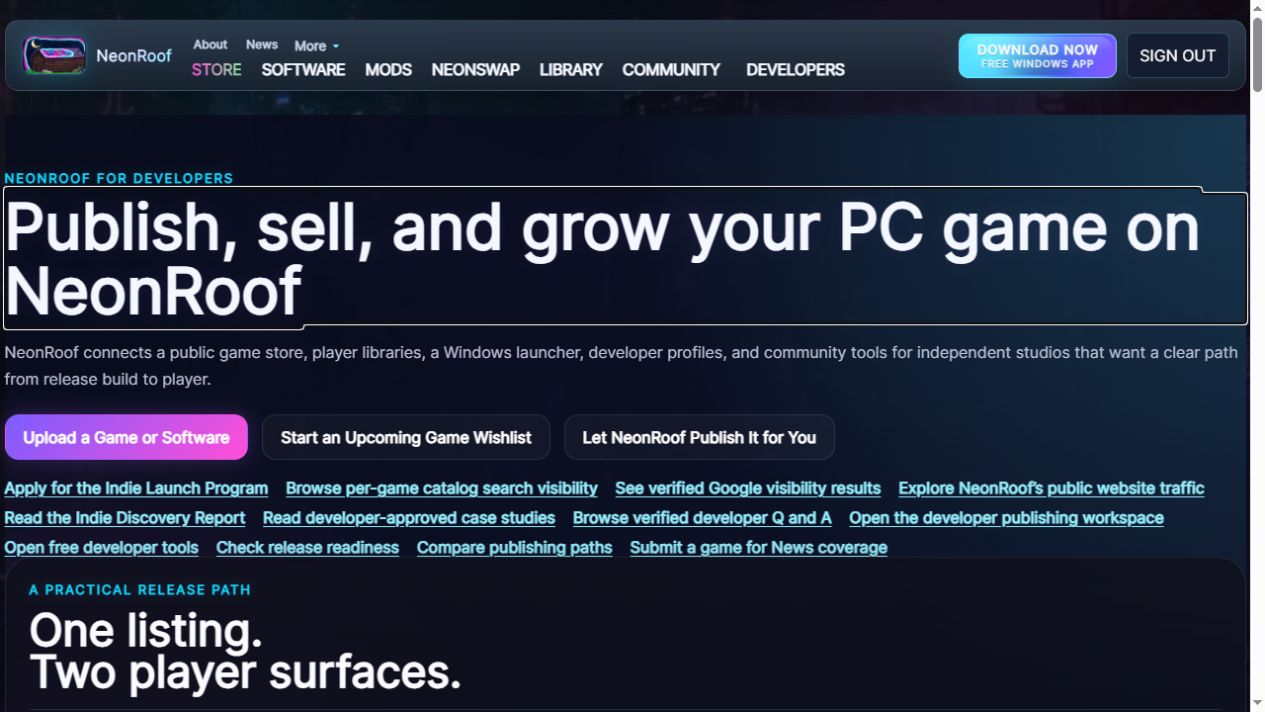
Give your indie game a page people can find and act on
A promising game needs more than a launch-day link. Players need to understand the experience, recognize the developer and know what to do next. NeonRoof connects those pieces through public game pages, wishlist campaigns, developer profiles, editorial coverage and a Windows game platform.
Still building? Start an upcoming-game wishlist campaign. Ready to release? Prepare a store listing and complete the publishing requirements for your game. Both paths give you somewhere useful to send interested players, with clear information that search engines can discover and understand.
This is a practical guide from NeonRoof, illustrated with actual public-interface screenshots captured on October 14, 2026. Forester and Albert Nemec appear as examples of page structure, not testimonials or claims about their sales or search performance.
Start with the publishing path that fits your game
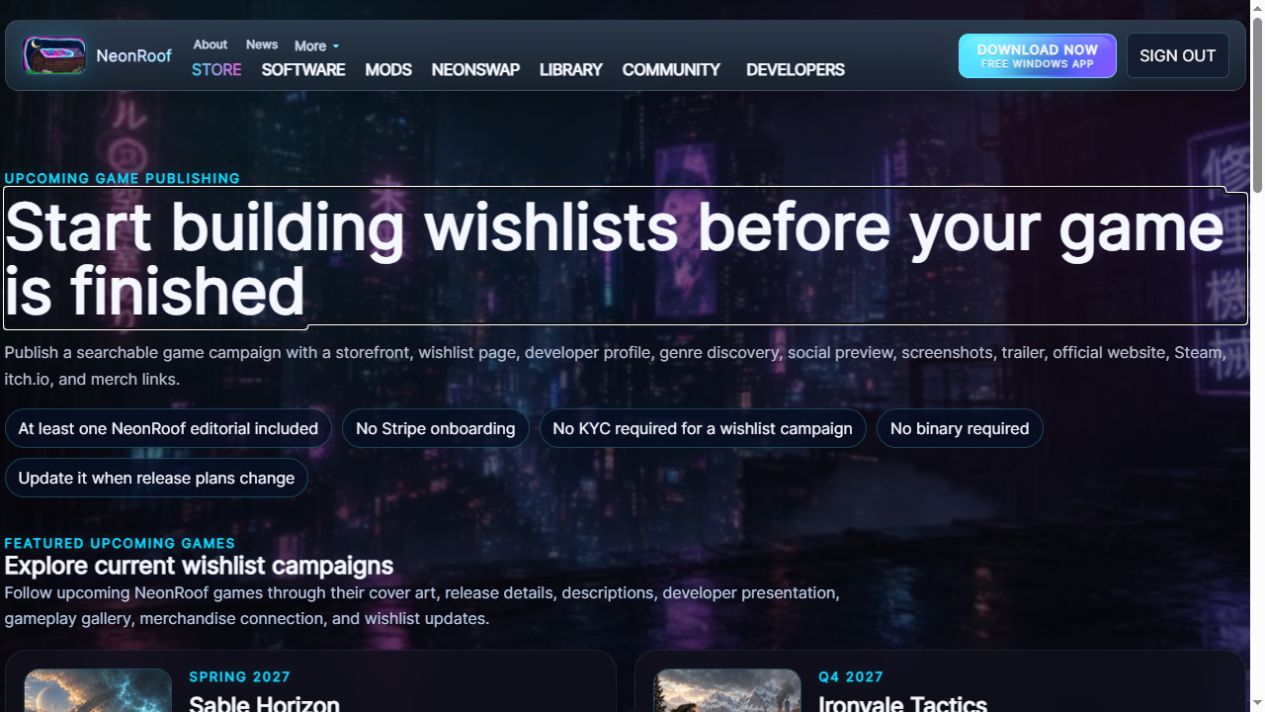
An unfinished game can already have a useful public presence. The NeonRoof wishlist publisher is designed for an upcoming title with a clear concept, release information and genuine media. Create a NeonRoof account, verify your email and prepare the campaign materials. A finished game binary, identity-document review and Stripe payout onboarding are not required for this wishlist route.
That distinction matters for a solo developer or small team. You can introduce the game while you are still testing mechanics, collecting feedback and deciding when a demo is ready. Use an honest release window or “to be announced” rather than inventing a date to fill a field.
The campaign can connect a public storefront, wishlist page, developer identity, screenshots, trailer and official links. The publishing page also includes editorial coverage in its stated campaign offer. Coordinate that coverage with NeonRoof and provide enough material for a factual introduction; it is not a promise of a favorable review or a particular ranking.
If your build is ready for release, start with the developer publishing overview or free assisted-publishing route. Review the current requirements before sending files or planning a paid launch.
Make the next step obvious to interested players
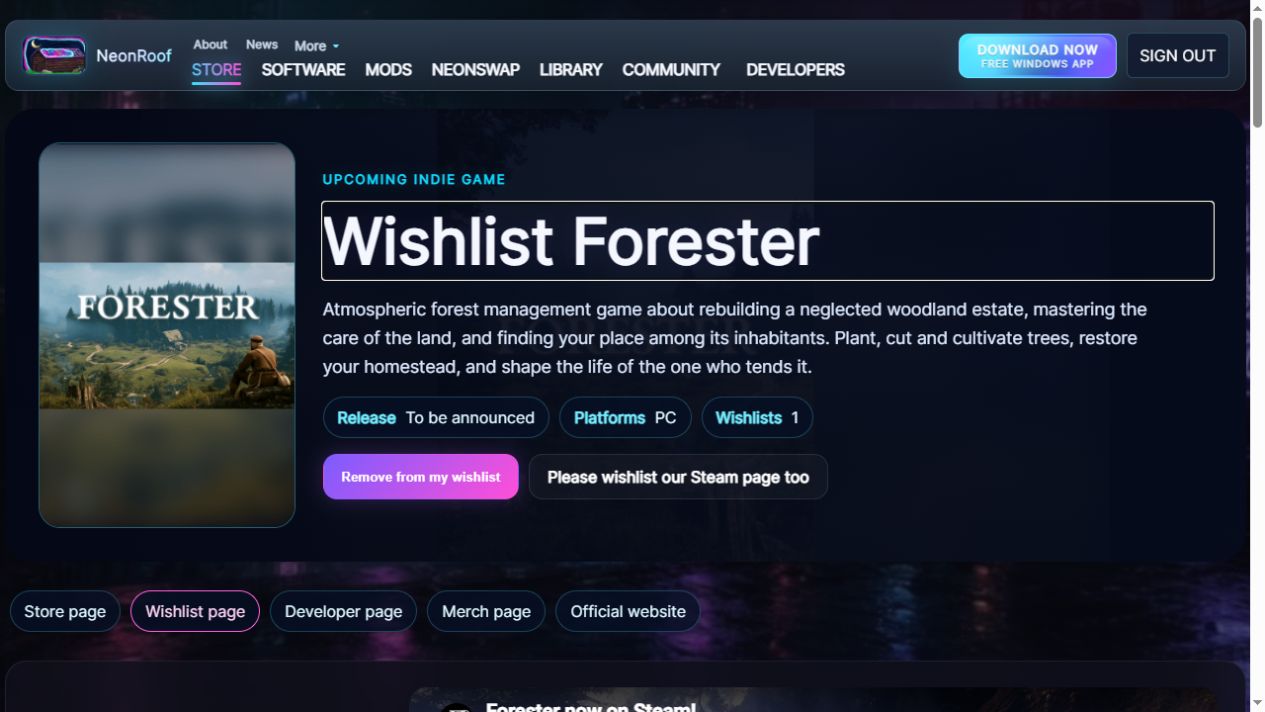
Look at the Forester wishlist page. It gives visitors a concise description, release status, platform information and clear actions. Players can follow the game on NeonRoof and use its separate Steam link. The page is an example of how to organize an upcoming release, not evidence that a particular layout guarantees conversions.
Your own introduction should explain what the player actually does. “Restore a woodland estate by growing trees and managing resources” is more informative than a list of broad promises. Name the genre, perspective, supported platform and distinguishing mechanic in ordinary language.
Give screenshots a job. Show the core activity, a representative environment and an understandable interface. Add a trailer if you have one you are authorized to publish. Keep the studio name, game title and release information consistent with your official website and other store pages.
A NeonRoof wishlist and a Steam wishlist are separate actions. A player following one page does not automatically create a wishlist on another platform. Label each destination clearly and give visitors a reason to return when you announce a demo, playtest or substantial update.
Build a studio identity that lasts beyond one announcement
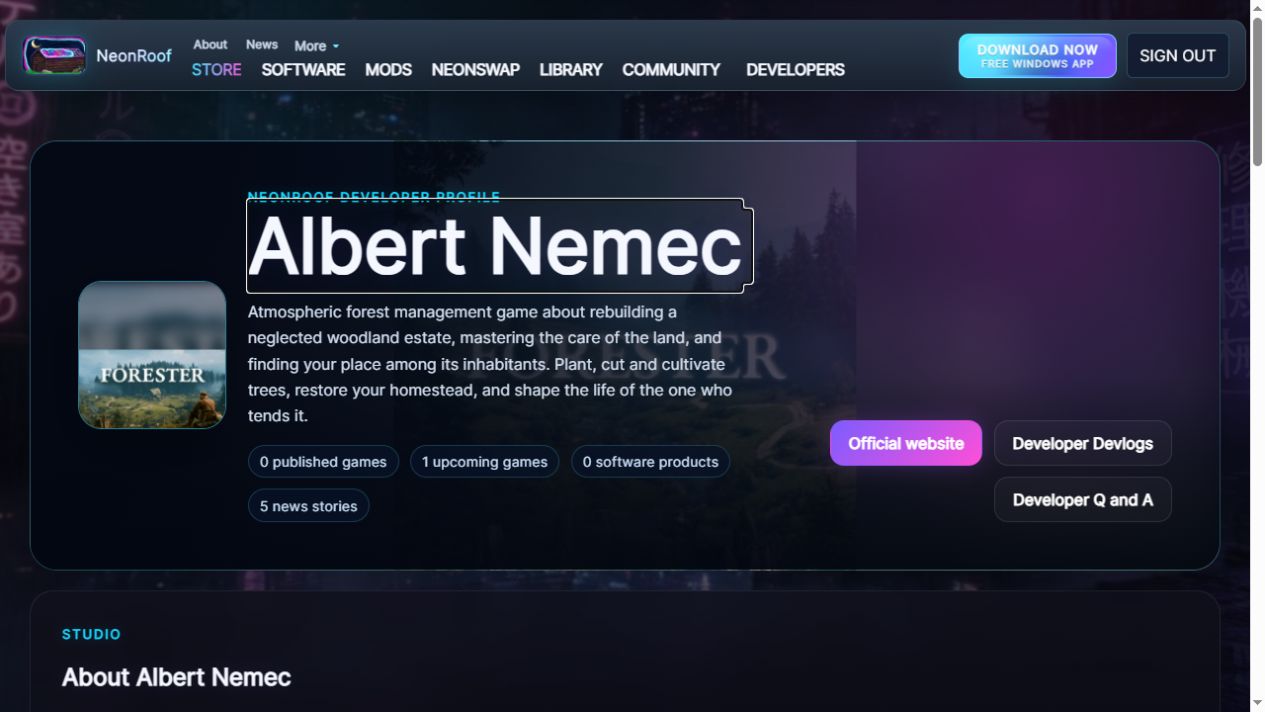
The Albert Nemec developer page shows the other half of a useful game presence: a recognizable creator connected to an upcoming release and related coverage. A public profile helps a player answer a simple question: who is making this game, and where can I follow their work?
Use a consistent studio or developer name, a factual biography and an official website link. Connect the relevant games and upcoming projects. When a player discovers an article first, those links should lead back to the game and its developer rather than leave them at an isolated story.
This also gives your future releases somewhere to belong. A second game does not have to start with a completely disconnected identity. Keep your profile accurate as the team, support channels and project status change.
Editorial coverage can add context that a short store description cannot: the design problem you are solving, a meaningful development milestone or the story behind the project. Submit a focused pitch through NeonRoof's game-news route. Supply real screenshots and facts; distinguish announcements from features players can already use.
What does NeonRoof contribute to SEO and AEO?
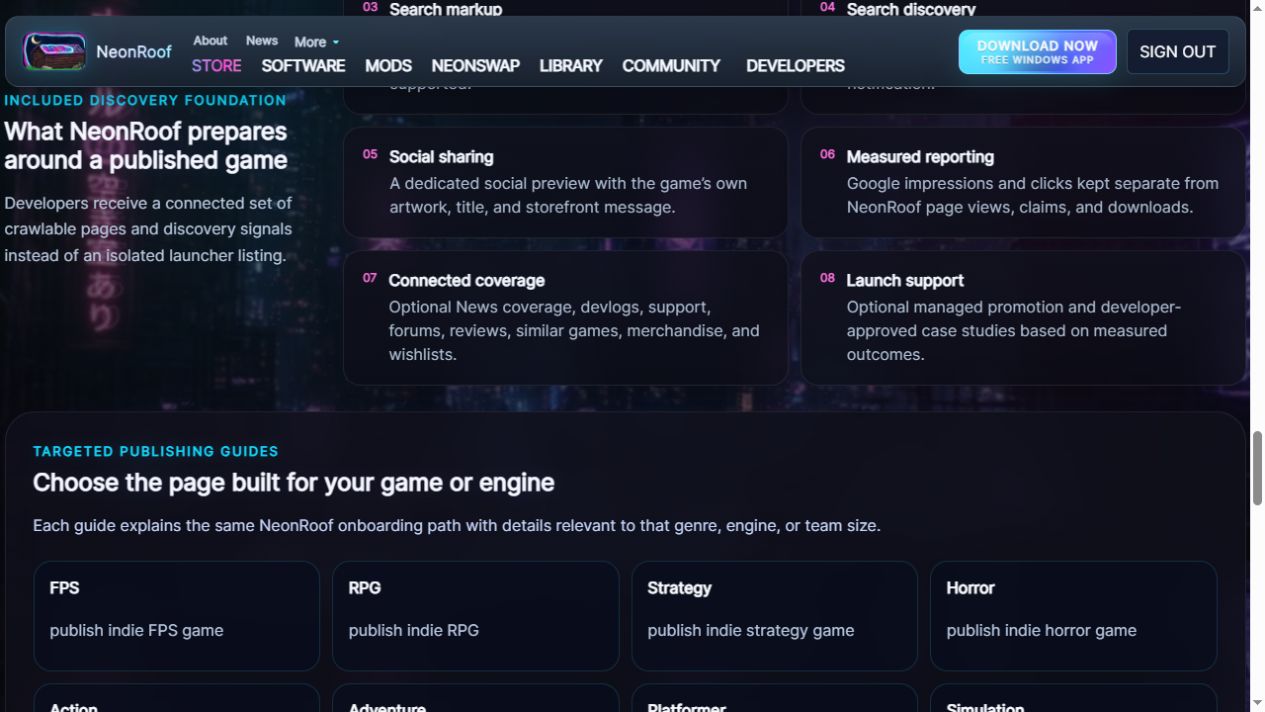
NeonRoof's value is a connected publishing foundation. Public game and developer pages give your project stable destinations. Descriptions, real screenshots, trailers, platform details and supported structured data provide context. Canonical URLs, internal links and sitemap coverage help search engines discover the relevant pages.
SEO means making that information discoverable and understandable in search. AEO, or answer engine optimization, means presenting useful facts so someone answering a question can understand them accurately. For a game, that starts with direct answers: what is it, who makes it, where can it be played, when is it available, and how does a player wishlist or buy it?
Google's guidance for AI search features says established SEO practices still apply; special AI markup is not required. Its people-first content guidance emphasizes original, useful information. A complete page with first-hand details is a stronger contribution than repeating keywords or publishing near-identical announcements.
NeonRoof does not guarantee indexing, first-page rankings, AI citations, wishlists or sales. The practical benefit is that your game can be presented through connected, useful public pages. Search visibility still depends on the material, competition, demand and the search engine's decisions. Those pages also give you clear destinations for press, community posts and your own website.
Ready to sell? Finish the release and payout requirements
Selling a game is a different stage from introducing an upcoming project. NeonRoof's standard release workflow requires developer approval and identity review. Paid titles also need Stripe payout readiness. Prepare your legal publishing authority, release build, pricing, support information, artwork and delivery details before scheduling the launch.
The developer overview currently lists a 10% NeonRoof platform fee on completed paid game sales. That is the platform fee, not a promise that every other processing cost, tax or adjustment is included. Read the current publisher terms and onboarding information for your situation.
Developers can use supported developer-controlled delivery, while NeonRoof-hosted storage is optional and has separate terms. Paid builds need protected delivery so that a publicly shared file URL does not become a substitute for purchasing the game. The assisted-publishing form is a useful starting point if you want help assembling the listing.
The website and Windows platform use the shared catalog. For supported releases, the Windows app connects discovery with a player's library, installation and launch workflow. Explain your own game's supported platforms and delivery method rather than assuming every catalog title uses the same installer.
Measure interest before calling it a successful launch
Track the full path: search impressions, search clicks, visits to your page, wishlist actions and, after release, claims, downloads or sales. These are different events. An impression is not a visit; a visit is not a buyer.
Separate site-wide traffic from your game's results. Check reporting dates and availability, and use game-specific figures when they are actually reported. If a report is unavailable, that is missing evidence, not a reason to estimate a success story.
Useful updates give people a reason to revisit the page: a playable demo, a newly explained system, improved accessibility or a confirmed release window. Refresh the information when something changes, not merely to make the page appear new.
A short preparation checklist for your first page
- Write a two-sentence description of the player experience.
- Prepare a consistent game title, studio name and official links.
- Supply clear cover and banner art, genuine screenshots and an authorized trailer if available.
- State the platform and real release status, including uncertainty.
- Choose the wishlist route or the approved release-and-sales workflow.
- Check every button, image, support link and mobile layout before sharing the page.
Questions indie developers ask
Can I publish a wishlist page before finishing my game?
Yes. The upcoming-game route does not require a finished binary. You still need a NeonRoof account, verified email and accurate campaign information with appropriate media.
Do I need Stripe or identity documents for a wishlist campaign?
Not for the wishlist-only route. Standard release publishing and paid sales have separate developer-review and payout requirements.
Can I sell a paid indie game on NeonRoof?
Yes, after the applicable publishing approval, identity checks and Stripe payout setup are complete. Confirm build delivery, rights and current commercial terms before going live.
Will a NeonRoof page automatically rank on Google or appear in AI answers?
No. NeonRoof provides a publishing and discovery foundation, but search engines decide what to index and show. Accurate content and clear answers support discovery without guaranteeing placement.
Does a NeonRoof wishlist count as a Steam wishlist?
No. They belong to separate platforms. Link to the official Steam page when appropriate and explain which wishlist each button affects.
Where should I start today?
Choose publish an upcoming-game wishlist if you are still building. Choose NeonRoof developer onboarding if you are preparing a release, or ask NeonRoof to help publish your game. Give players a useful place to discover the work you are putting into it.
No comments yet. Start the conversation with a useful, on-topic response.