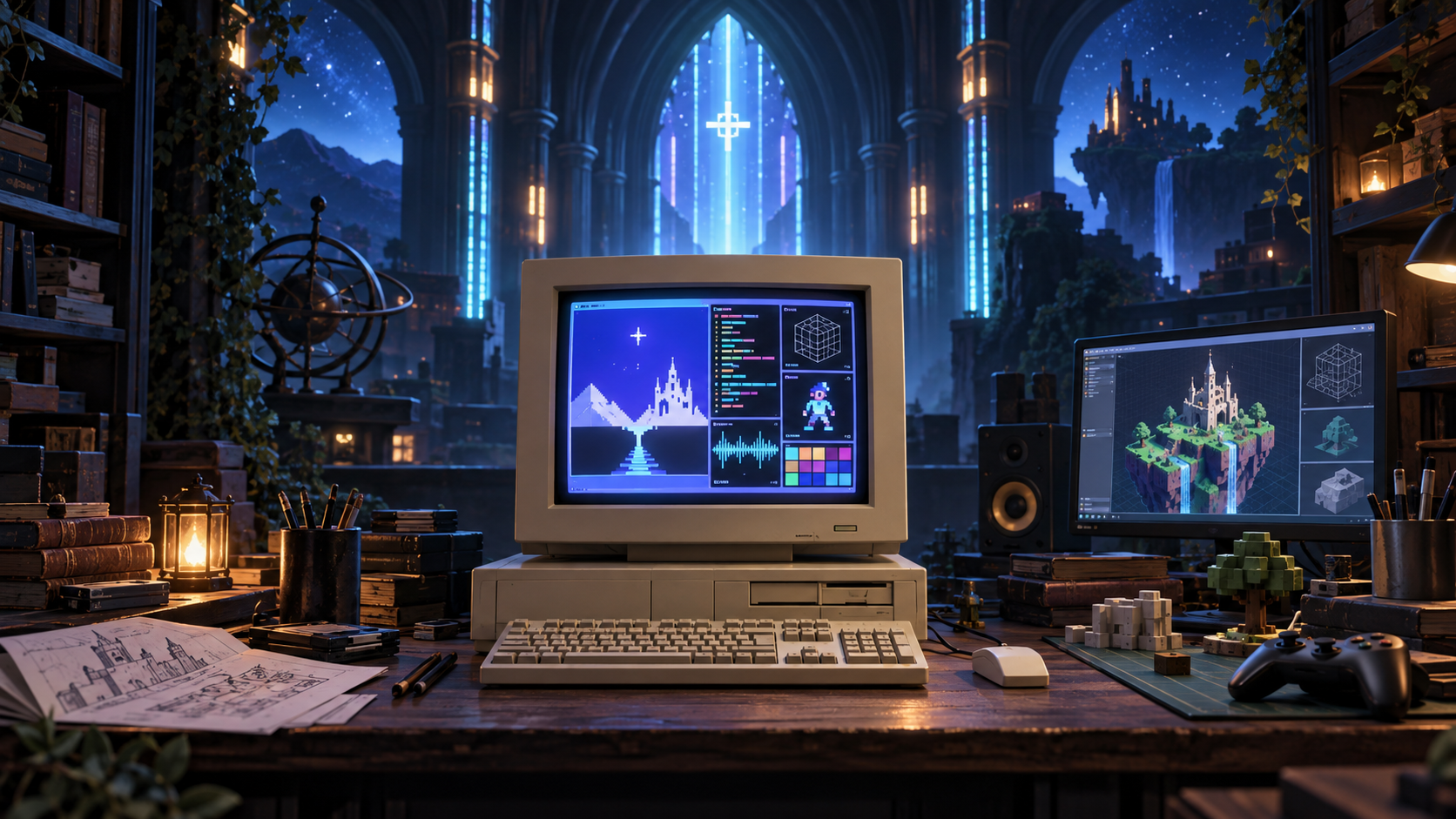
Join players and independent developers in the NeonRoof Discord community to discuss these games, publishing, and practical game-development work.
Who created TempleOS?
Terry A. Davis created TempleOS, a public-domain, 64-bit operating system built as a deeply personal environment for recreational programming. The official TempleOS documentation describes an x86-64 system with its own kernel, compiler, editor, shell, graphics, sound, tools, demos, and games. Davis also created HolyC, the programming language at the center of the system.
That breadth makes TempleOS one of computing's clearest examples of independent software authorship. It was not a commercial team imitating a general-purpose operating system. It was one creator deciding what the computer should be, then carrying that idea through the entire stack.
Explore the TempleOS software page on NeonRoof and the independent Terry A. Davis developer profile for the verified project links, documentation, public-domain notice, screenshots, and download source.
TempleOS was also a place for games and playful programming
The official welcome document calls TempleOS an operating system for recreational programming and points readers to included game and demonstration programs. That matters to indie game developers. A game does not begin with a storefront. It begins with an environment where a creator can test an idea, draw something on the screen, make sound, write rules, and play with the result.
TempleOS connected those activities inside one coherent system. Modern developers will usually choose safer and more portable tools, but the creative principle still holds: reduce the distance between an idea and a playable experiment. The NeonRoof game-development software collection brings together current engines, art tools, audio tools, capture software, and release utilities for that purpose.
What can a solo game developer learn from Terry Davis?
Choose constraints deliberately
TempleOS used a narrow visual and technical target. Those choices were unusual, but they gave the project a recognizable identity and kept its design internally consistent. An indie game can benefit from the same discipline. Choose a platform, visual language, input model, and performance budget that a small team can actually finish.
Build tools that protect the creative loop
Davis did not separate the operating system from the act of programming inside it. Indie teams do not need to write a compiler, but they should remove repeated friction from builds, asset imports, testing, screenshots, and releases. Start with free game-development software for indie developers, then keep only the tools that make the project easier to understand and reproduce.
Let the work have a clear identity
TempleOS is unmistakable. Its technical decisions, visual limits, language, and purpose all point in the same direction. A small game can compete through clarity instead of scale. A readable cover, honest description, distinct mechanic, consistent screenshots, and a useful developer page give players something they can remember.
Finish a complete vertical slice
A finished small system teaches more than a folder of disconnected prototypes. The practical equivalent for a game developer is a vertical slice that proves input, gameplay, art direction, audio, saving, performance, and packaging. The indie game toolchain from prototype to players explains how to carry that slice into a tested public release.
Remember the person, not only the mythology
Davis's life included serious mental-health struggles. Those struggles should not be romanticized, used as entertainment, or treated as the source of his engineering ability. The current TempleOS project site memorializes him and notes his family's request that supporters consider organizations that ease suffering caused by mental illness. A respectful account can recognize both the scale of his work and the human difficulty surrounding it.
Continue the independent creator cluster
- Read how to publish an open-source game with clear licenses and attribution.
- Compare the best free software for indie game development.
- Build an art and trailer workflow with Blender, GIMP, and HandBrake.
- Learn how to publish an indie game without a traditional publisher.
When your own game is ready, start NeonRoof developer onboarding or ask NeonRoof to help publish the game at no charge.
No comments yet. Start the conversation with a useful, on-topic response.