Join players and independent developers in the NeonRoof Discord community to discuss these games, publishing, and practical game-development work.
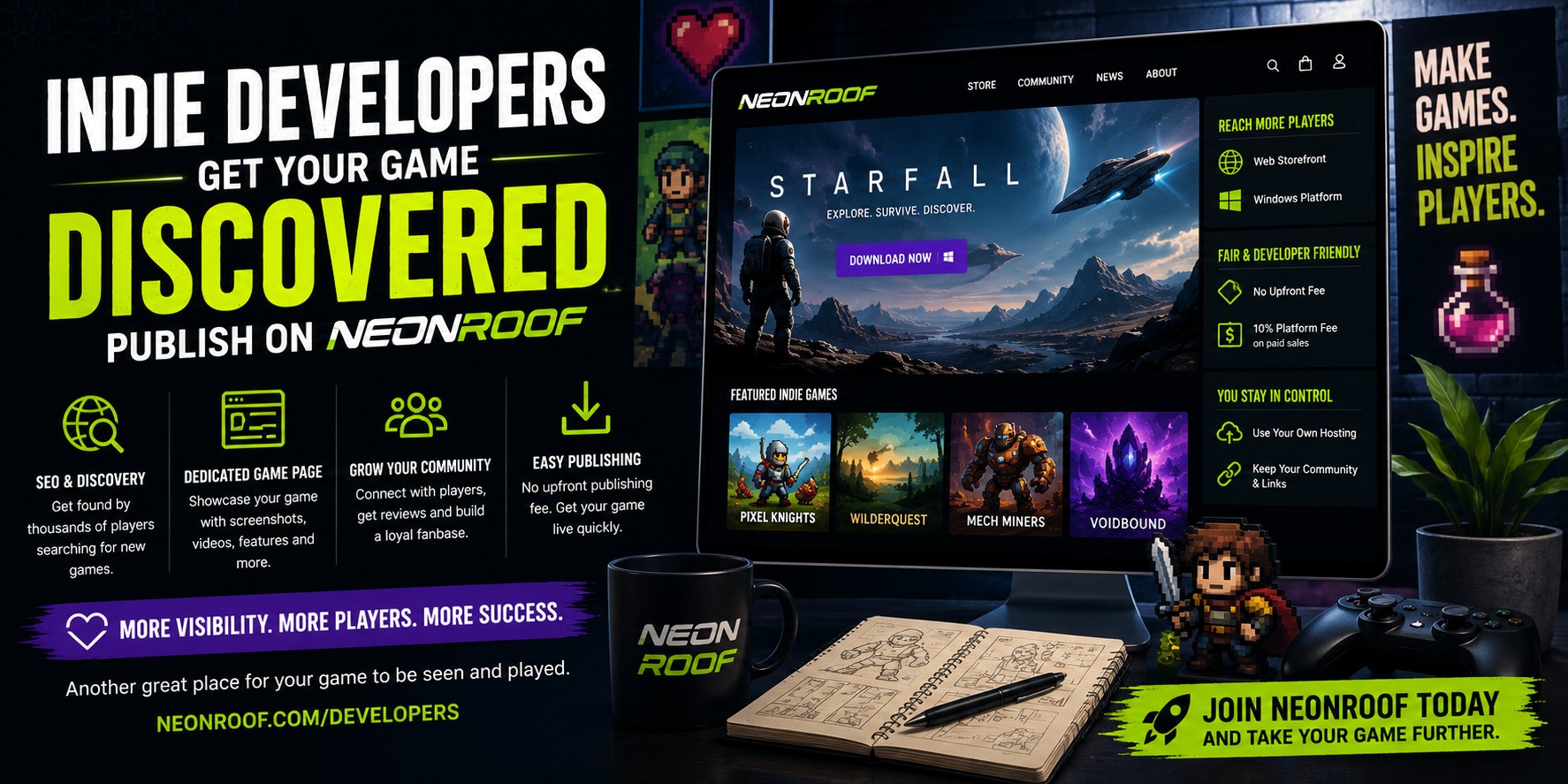
Building a great indie game is only half the battle. NeonRoof gives independent developers another place to publish, build searchable game pages, reach PC players and create long-term visibility without paying an upfront publishing fee.
##
Making an indie game is difficult.
Getting people to realize it exists can be even harder.
A developer can spend two years programming combat systems, designing levels, composing music, fixing bugs, creating artwork and polishing a game only to release it into a market containing thousands of other titles fighting for the same players.
That is the uncomfortable reality of independent game development in 2026.
The problem is not necessarily that there are too many bad games.
There are too many games.
A genuinely excellent indie title can disappear simply because nobody knows to search for it.
That means independent developers increasingly have to think about something that has very little to do with programming.
Discovery.
And discovery is one of the main problems NeonRoof is being built to help solve.
A Great Indie Game Nobody Can Find Is Still a Game Nobody Is Playing
Large publishers can solve discovery with money.
They can purchase advertisements.
Pay streamers.
Buy homepage placements.
Run social campaigns.
Send review copies to hundreds of publications.
Release cinematic trailers.
Sponsor events.
Hire public relations companies.
Independent developers usually cannot do all of that.
A solo developer may be programmer, artist, marketer, support technician and community manager at the same time.
A small studio might have an incredible game but almost no advertising budget.
That creates a strange situation.
The ability to make games has become more accessible than ever, while the ability to get attention has become increasingly difficult.
Engines such as Godot have made professional game development tools available to virtually anyone.
We recently explored that side of independent development in Godot + Rust: A Powerful Open-Source Stack for the Next Generation of RTS Games.
Tools are becoming more accessible.
Distribution needs to become more accessible too.
Your Game Should Exist in More Than One Place
One of the biggest mistakes an independent developer can make is assuming that publishing a game means choosing one storefront and stopping there.
It does not.
Your Steam page can be important.
Your itch.io page can be important.
Your own website can be important.
Your Discord server can be important.
Your YouTube videos can be important.
Your social media can be important.
And another legitimate storefront can be important.
These things do not have to compete with one another.
They can support one another.
Every page about your game creates another potential way for someone to encounter its name.
Every legitimate link pointing toward your website or existing storefront gives players another route into your project.
Every article mentioning your game creates another opportunity to appear in a search.
Every new audience creates another chance to find the player who ends up recommending your game to somebody else.
That is why NeonRoof is not being built around the idea that developers should leave Steam, itch.io or another platform.
It is being built around a much simpler idea:
Why should your game have only one door?
NeonRoof Gives Indie Games Their Own Searchable Storefront Page
One of the most important parts of publishing a game online is having a page that can actually explain what the game is.
The NeonRoof developer platform gives developers the ability to create a complete public storefront around their game.
A NeonRoof game page can include:
- Game title
- Description
- Cover artwork
- Hero artwork
- Screenshots
- Trailer
- Genres
- Tags
- System requirements
- Pricing
- Download information
- Developer website
- Support links
- Community links
- Player reviews
- Related games
- Downloadable builds
That matters for players.
It also matters for search engines.
A game should not simply exist as a thumbnail buried inside an application.
It should have a real web page.
Look at the 0 A.D. page on NeonRoof.
The page does not simply say "0 A.D." and provide a download button.
It contains information describing the game, its developer, genre, gameplay, licensing, screenshots, trailer, system requirements, community resources and related content.
That gives search engines considerably more information to understand.
For an indie developer trying to establish a name online, that matters.
SEO Can Keep Working After Your Social Post Disappears
Social media is useful.
It is also incredibly temporary.
You publish a post.
People see it.
A few hours later another thousand posts have pushed it down the feed.
Maybe you get a burst of traffic.
Then it disappears.
Search traffic works differently.
Someone might search:
best free FPS games for PC
indie strategy games
free multiplayer games
games for low-end PCs
best open-source games
new indie PC games
months after an article was originally published.
If the right page appears in that search, the content can continue sending people toward the games featured inside it.
That is one of the reasons NeonRoof has invested heavily in NeonRoof News.
The storefront provides somewhere for a game to live.
The news site provides another way for people to discover why they might want to play it.
NeonRoof News Creates Another Discovery Layer
Consider our article covering the 6 Best Free FPS Games for PC to Play in 2026.
That article does not simply discuss first-person shooters in general.
It introduces players to individual games such as Unvanquished, OpenArena, Xonotic, OpenSpades and others.
Players searching for something to play can discover a title they may never have searched for by name.
That distinction is important.
A player cannot search Google for your game's name if the player has never heard of your game.
That is the discovery problem.
But that same person might search:
best indie FPS games
free FPS games for PC
multiplayer PC games
games like Quake
and discover your game through an article answering the question they actually asked.
We use the same strategy with other genres.
Our guide to 9 Best Free Strategy Games for PC to Play in 2026 gives strategy players another route toward games they might never have searched for directly.
Our article on 7 Great Free PC Games You Can Play Right Now on NeonRoof brings several different genres together.
That creates a network.
A player searches for a subject.
The player discovers an article.
The article introduces a game.
The game has its own NeonRoof storefront.
The storefront can link to the developer.
And the developer gains another potential player.
That is the kind of discovery loop NeonRoof wants to build.
A Game Can Become More Than One Search Result
Imagine an independent developer creates a multiplayer survival game called Example Island.
The traditional approach might produce:
examplegame.com
and:
store.steampowered.com/examplegame
Those pages are important.
Now imagine the same game also has:
neonroof.com/platform/store/example-island
Then NeonRoof publishes:
10 Indie Survival Games Worth Playing in 2026
Later:
Best Multiplayer Indie Games to Play With Friends
Then perhaps:
How Example Studio Built Example Island With Godot
And eventually:
The Best PC Survival Games From Small Indie Studios
Now the developer has multiple pages on the web discussing the project.
Those articles can link to the NeonRoof game page.
The NeonRoof game page can link to the developer's website.
The developer can link back to the coverage.
Those connections give both people and search engines more ways to understand what the game is.
That is far more powerful than uploading a ZIP somewhere and hoping people stumble across it.
NeonRoof Is Already Building This Around Real Games
This is not just a theoretical SEO plan.
NeonRoof is already using News articles to create additional discovery around games and projects available through the platform.
Players interested in free shooters can find the Best Free FPS Games for PC in 2026.
Players interested in strategy can discover the Best Free Strategy Games for PC in 2026.
Players looking broadly for something new can find 7 Great Free PC Games You Can Play Right Now.
Developers interested in technology can read about Godot and Rust for building next-generation RTS games.
Players and developers interested in alternative PC gaming ecosystems can explore our coverage of Xodus and the effort to break another Linux gaming barrier.
That creates something bigger than a store.
It creates an interconnected collection of game pages, technology articles, recommendations and developer stories.
And that is exactly the sort of content ecosystem that can help smaller games become easier to discover.
Early Indie Developers Have an Opportunity
There is another advantage to joining a growing platform early.
Attention is finite.
When a platform contains hundreds of thousands of games, one more indie title is another entry inside an enormous catalog.
When a platform is still growing its developer community, individual games can receive considerably more attention.
NeonRoof is actively looking for independent developers.
That means early developers have an opportunity to help shape what the platform becomes while benefiting from a much smaller field competing for attention.
We want to know about your game.
We want to know who built it.
We want screenshots.
Trailers.
Development stories.
Technical challenges.
Interesting mechanics.
Unusual ideas.
Developer interviews.
Major updates.
New releases.
If there is an interesting story behind a game, there may be an interesting NeonRoof News article behind it too.
We cannot promise that every submitted game will rank first on Google.
Nobody legitimately can.
What we can do is build proper pages, publish useful content, create internal links and give search engines multiple opportunities to discover relevant information about games on the platform.
That is real SEO.
You Can Publish Without an Upfront Publishing Fee
Visibility is only useful if getting onto the platform is financially realistic.
That is why NeonRoof offers publishing paths that do not require an upfront publishing fee.
Developers can start through the NeonRoof developer publishing system.
If you already host your game's files yourself, you can use your own protected storage bucket or delivery API without paying NeonRoof for game hosting.
A public download URL can also be used where appropriate.
Optional NeonRoof-managed hosting is available for developers who want NeonRoof to handle build storage instead.
That distinction matters.
You do not need to purchase hosting from NeonRoof simply to create a game storefront.
For developers selling a paid game, NeonRoof currently uses a 10% platform fee on sales.
Stripe handles developer payout onboarding, meaning NeonRoof does not need to store a developer's bank account or routing information itself.
The goal is to make publishing another distribution channel financially practical for small studios.
Publish Once and Reach the Web and Windows Platform
Another important difference is that NeonRoof is not simply a website containing download links.
A developer's catalog entry can appear across both the web storefront and the NeonRoof Windows platform.
Players can discover games through the NeonRoof PC game store.
They can also install the NeonRoof Windows platform, which is available through Microsoft Store.
Inside the Windows experience, players can browse games, manage their libraries, interact with friends and participate in community features.
That means a developer is not creating separate listings for every NeonRoof surface.
The same underlying catalog can reach players through both the web and the Windows application.
Your Existing Storefronts Can Still Matter
Publishing on NeonRoof does not mean pretending other platforms do not exist.
Quite the opposite.
We want developers to maintain their existing communities.
If you already sell on Steam, keep selling on Steam.
If itch.io works for your audience, keep your itch.io page.
If you sell directly through your website, keep doing that.
If your players live in Discord, keep your Discord community.
NeonRoof can become another part of that network.
A NeonRoof page can point players toward the developer's official website and support resources.
News coverage can mention the developer and project.
The developer can share those stories with their existing community.
That creates additional legitimate connections around the game instead of forcing everything into one closed ecosystem.
The goal is additional discovery.
Not exclusivity.
Smaller Developers Need More Backlinks and Mentions
For indie developers, backlinks can be especially difficult to earn.
Nobody links to something they do not know exists.
That creates another vicious cycle.
A new developer has very little online authority.
Because they have little authority, they struggle to rank.
Because they struggle to rank, fewer people discover the game.
Because fewer people discover the game, fewer websites talk about it.
Because fewer websites talk about it, the developer earns fewer links.
Breaking that cycle requires exposure.
A feature on NeonRoof News can provide another legitimate page discussing a developer's game and linking readers toward relevant resources.
A NeonRoof storefront creates another indexed location associated with the title.
Genre roundups create additional internal pathways toward that storefront.
Developer stories can create even more.
Over time, those connections can become valuable.
Again, SEO is never guaranteed.
Google decides what Google ranks.
But creating useful, relevant, interconnected content gives search engines far more to work with than a single isolated store listing.
Give Us Something Interesting to Write About
Developers can also help themselves.
Do not simply submit:
Here is my game.
Tell the story.
Why did you build it?
Are you a solo developer?
What engine did you use?
Did you create your own engine?
What unusual mechanic makes the game different?
Did development begin as a school project?
Did you spend five years creating it after work?
Does your multiplayer system solve an unusual technical problem?
Did your community help design part of the game?
Are you launching on Linux?
Did you build something nobody else thought would work?
Those details matter.
They give players something to remember.
They also give publications something to write about.
A good developer story can turn:
New Game Released
into:
How One Developer Spent Four Years Building a Multiplayer RPG Without a Publisher
Which one would you click?
Exactly.
We Want Indie Developers Before They Become Famous
NeonRoof is interested in games before everybody already knows about them.
A platform that only begins caring about a developer after that developer becomes successful is not solving much of a discovery problem.
We want the unknown project.
The first commercial release.
The strange game built by two friends.
The solo developer creating something after work.
The tiny studio trying to build its first community.
The open-source team maintaining a game because they love it.
The developer who has a fantastic Steam page with 37 reviews and deserves 3,700.
Those are exactly the projects alternative game platforms should be helping people discover.
Indie Game Marketing Should Compound
The best marketing does not disappear immediately after you stop paying for it.
Think about the difference.
An advertisement runs for a week.
You stop paying.
The advertisement disappears.
A useful article can remain searchable.
A game page can remain indexed.
A developer interview can remain online.
A comparison article can continue sending readers toward a game.
A review can be shared again.
A tutorial can be discovered months later.
A news story about a major update creates another page.
This is why SEO is so valuable for independent developers.
It can compound.
One page becomes five.
Five become twenty.
Those pages begin connecting to each other.
And gradually the game develops a larger footprint on the web.
NeonRoof wants to help developers build that footprint.
There Is Room for Another PC Gaming Platform
Steam is not disappearing.
Neither is itch.io.
That is fine.
NeonRoof does not need either platform to disappear.
PC gaming has always benefited from choice.
We explored that larger idea while looking at alternative Linux gaming technology in our article Xbox Game Pass on Linux? Open-Source Project Xodus Takes Aim at Another Gaming Wall.
Developers constantly create new engines.
New operating systems.
New compatibility tools.
New games.
New distribution models.
There is no reason game discovery itself should stop evolving.
More legitimate platforms can mean:
more competition,
more discovery,
more developer options,
more communities,
and more ways for a good game to find the right players.
That is healthy.
What Developers Get From NeonRoof
For an independent developer considering another distribution channel, the NeonRoof proposition is straightforward.
A dedicated game page
Your game gets a real web storefront with descriptions, artwork, screenshots, trailers, system requirements, developer links and community resources.
Web discovery
Players can discover the game directly through the NeonRoof website without first installing an application.
Windows platform discovery
The same catalog reaches players using the NeonRoof Windows platform.
No upfront publishing fee
Developers can use supported self-hosted delivery options without paying an upfront fee simply to publish a game.
10% platform fee on paid sales
For paid games sold through NeonRoof checkout, the current NeonRoof platform fee is 10%.
Developer-controlled links
Your NeonRoof storefront can point players toward your official website, support resources and community.
NeonRoof News opportunities
Interesting games, developers and technology may become candidates for editorial coverage, interviews, roundups and other NeonRoof News content.
Internal discovery
Games can appear in genre pages, related-game sections, news articles, search pages and other parts of the NeonRoof ecosystem.
Community
The platform is being built around games, friends, profiles, direct messages and chat rather than treating the purchase button as the end of the relationship.
Your Game Deserves More Than One Chance to Be Discovered
You already did the hard part.
You built the game.
Now people have to find it.
There is no single magic solution to indie game marketing.
NeonRoof cannot guarantee success.
Steam cannot guarantee success.
A viral TikTok cannot guarantee success.
A YouTube video cannot guarantee success.
SEO cannot guarantee success.
What developers can do is create more legitimate opportunities for discovery.
More searchable pages.
More storefronts.
More articles.
More backlinks.
More communities.
More conversations.
More chances for somebody to stumble across the game and think:
That looks interesting.
Sometimes that one player becomes ten.
Ten become one hundred.
One of them makes a video.
Another writes an article.
Another tells their Discord server.
Discovery compounds.
But it has to start somewhere.
Publish Your Indie Game on NeonRoof
If you are an independent developer looking for another way to get your game in front of PC players, we would like to see what you are building.
You do not have to abandon the storefronts you already use.
You do not need an enormous advertising budget.
And you do not need to pay an upfront publishing fee simply to create another place for players to discover your game.
Start with the NeonRoof developer publishing page.
See the platform players are using on the NeonRoof Windows Platform page.
Browse the existing NeonRoof PC Game Store.
Then explore NeonRoof News to see the kind of game coverage, developer stories, technology articles and recommendation guides we are building around the PC gaming community.
Your game should not have to become famous before people start paying attention to it.
Sometimes it just needs another place to be found.
Bring it to NeonRoof.
Where should you publish your indie game?
Our complete guide to choosing Steam, itch.io, NeonRoof, and your own website compares the role of each channel and provides a practical release checklist.
Practical developer publishing library
Plan the release with the complete 90-day indie launch checklist and prepare outreach with How to Make an Indie Game Press Kit Journalists Can Actually Use.
Turn discovery into a sustainable process
Connect content, community, demos, and measurement with How to Market an Indie Game Organically in 2026.
Free tools for building and publishing an indie game
Continue with the NeonRoof software collection to turn an idea into game assets, marketing material, and a public game page ready for players.
No comments yet. Start the conversation with a useful, on-topic response.