
A useful indie press kit is not a folder full of random images and it is not a long press release. It is a stable, public source that lets a journalist, reviewer, YouTube creator, streamer, newsletter editor, event organizer, or business partner understand the release quickly and obtain accurate, reusable material without waiting for an email reply.
The best press kit removes friction. It answers the basic questions, supplies publication-ready media, identifies the people behind the work, explains how to request access, and makes the rights and contact information clear.
This guide focuses on the developer workflow. It does not promise coverage and it does not recommend mass-emailing unrelated outlets. It shows how to build a professional source that makes legitimate editorial work easier.
What is an indie press kit?
An indie press kit is a web page, or a web page with organized downloads, containing verified information and approved media for a studio and its release. It should be readable without downloading a ZIP file, while also offering original files for people who need them.
The free presskit() project by Rami Ismail helped establish a practical model: give the press the facts and assets needed to work without forcing the developer to rebuild the same package for every request. You do not have to use that exact tool, but the principle remains sound.
If launch planning is still incomplete, begin with How to Launch an Indie Game in 2026: The Complete 90-Day Checklist. The press kit should be built early enough to support the store-page reveal, preview outreach, launch, updates, and long-term coverage.
What journalists and creators need immediately
A visitor should be able to answer these questions in less than a minute:
- What is the public title?
- What kind of experience is it?
- What is the strongest distinguishing idea?
- Who made it?
- What is the release status and date?
- Which platforms and languages are supported?
- What does it cost?
- Where is the official storefront or download?
- Is preview or review access available?
- Who can answer a question?
- Which images, video, and logos may be reused?
Put the answers near the top. Do not hide basic facts inside a cinematic paragraph or require a visitor to watch a trailer before learning the release date.
The complete indie press-kit structure
1. A factual header
Show the title, developer or studio name, one-sentence description, release status, platforms, date, price, official website, storefront links, and press contact. Include a clean horizontal visual or logo, but keep text readable and the page fast.
The one-sentence description should identify the format and differentiating idea without unsupported superlatives. “The greatest adventure ever created” gives a journalist nothing verifiable. A concrete sentence describing the activity, structure, audience, and unusual feature is more useful.
2. A compact factsheet
Create a scannable list:
- developer and publisher;
- headquarters or working location, if public;
- founding year, if relevant;
- release date or status;
- supported operating systems and storefronts;
- supported languages;
- input methods;
- multiplayer or online requirements;
- pricing;
- official site and social accounts;
- business and press contact;
- content and accessibility notes.
Only publish facts you are comfortable making public. Personal home addresses, private phone numbers, tax details, unpublished legal names, account credentials, private analytics, and embargoed information do not belong in a public press kit.
3. Short and long descriptions
Provide three lengths:
- One sentence: useful for listings, captions, and introductions.
- One short paragraph: useful for a newsletter, event entry, or creator description.
- A fuller overview: useful for someone researching a feature or interview.
Keep facts consistent across all three. Do not stuff the long description with every minor feature. Explain the central activity, structure, tone, audience, progression, and what makes the release meaningfully different.
4. Key features with evidence
Use four to seven concise points. Pair each claim with a concrete detail. “Immersive world” is vague. “A continuous environment with no loading screens between regions” is specific. “Innovative combat” is vague. Explain the actual decision the player makes.
If a feature is planned but not available, label it. Valve's official Steam review process requires public store claims to match the current build. A professional press kit should meet the same standard even when it is hosted elsewhere.
5. Developer and studio biography
Include a short biography explaining who is behind the work, where the studio is based if public, how the team formed, relevant experience, development values, and previous releases. Provide the preferred names, roles, and pronouns of people available for interviews.
Keep the biography factual. A small first-time team does not need to imitate a multinational company. The honest story of how and why the studio works can be more memorable than corporate language.
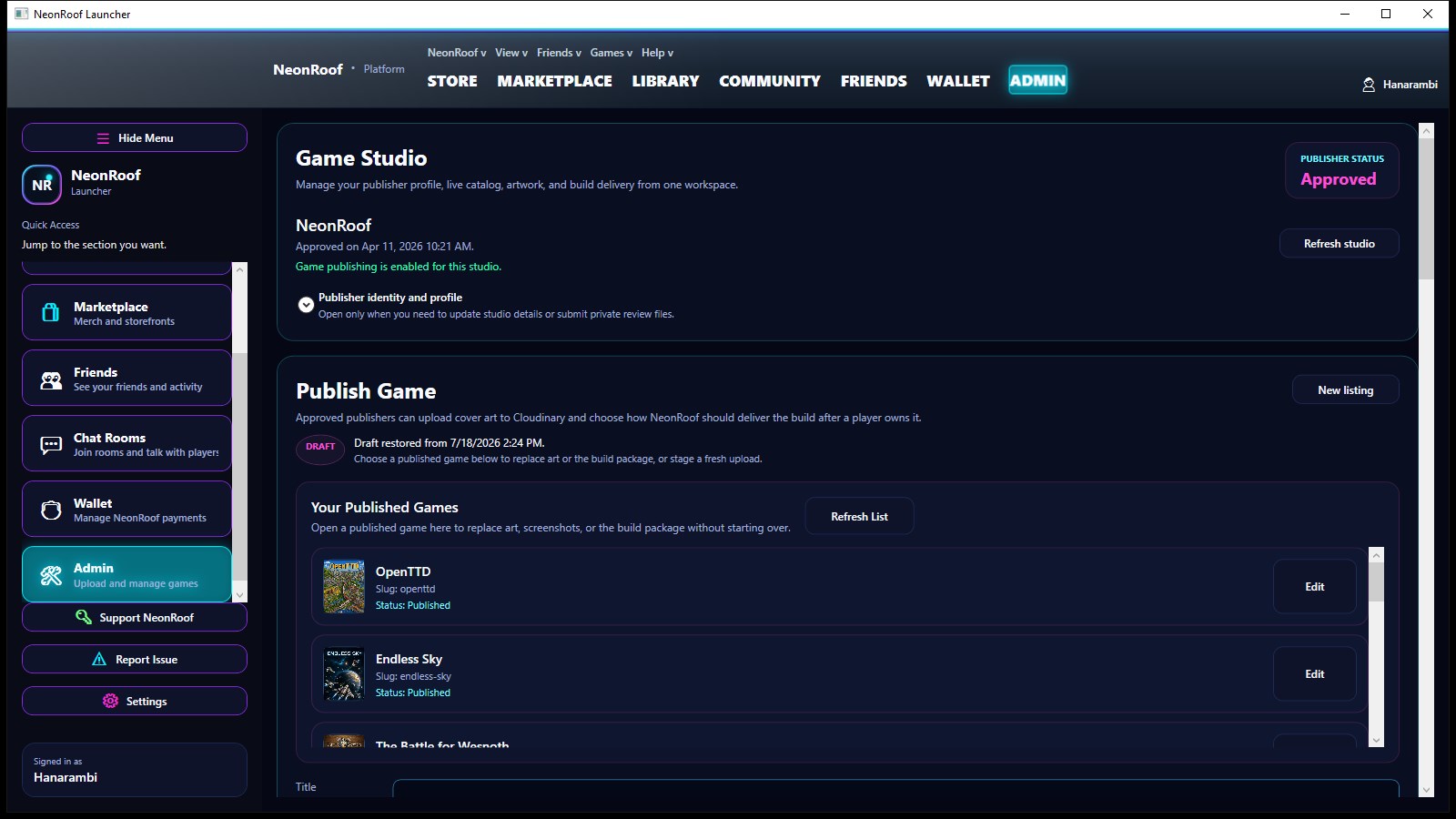
NeonRoof developers can also create a permanent studio presence through the developer publishing center. The indie game SEO guide explains how an official studio profile, storefront, press kit, and editorial coverage can support the same verified identity.
6. High-resolution screenshots
Offer a curated selection rather than hundreds of unsorted captures. Each screenshot should be sharp, correctly exposed, free of accidental debug information, and representative of the current build. Include the interface when it helps explain the experience. Keep clean interface-free versions only when they are genuinely useful.
Use descriptive filenames, such as `studio-title-environment-night-01.jpg`, instead of `Screenshot_Final_FINAL2.png`. Provide brief captions and alt text that explain what appears in the image. State whether cropping is permitted and whether a credit line is required.
Steam's current graphical asset documentation requires high-resolution widescreen gameplay screenshots for its store presence. Even when press-kit files are not Steam assets, maintaining large clean masters makes it easier to prepare platform-specific versions correctly.
7. Logos and brand assets
Provide:
- studio logo in SVG and transparent PNG;
- title logo in SVG or high-resolution transparent PNG;
- light and dark variants when needed;
- a square icon;
- horizontal and stacked lockups;
- a short usage note;
- required credit or trademark wording.
Do not make writers extract a logo from a screenshot. Do not place every logo on a colored rectangle that cannot be removed. Test transparent assets on light and dark backgrounds.
8. Video and trailer links
Embed the primary trailer and provide a direct link to its official YouTube page or approved host. Include the title, duration, publication date, language, caption availability, and whether the video can be embedded. If downloadable b-roll is available, identify its resolution, frame rate, audio status, and usage permission.
Steam's official trailer guidance notes that viewers may have less than ten seconds to understand a release and may watch without audio. That is useful beyond Steam. Put recognizable material early, make the message work silently, and caption spoken information.
9. Storefront and access links
List every authorized destination with a plain-language label. Distinguish between wishlist, demo, purchase, free download, early access, private preview, and developer website. Remove expired keys and temporary links.
Developers deciding which destinations belong in the plan can read Where to Publish Your Indie Game in 2026. The guide compares Steam, itch.io, NeonRoof, and an official site without pretending one channel fits every release.
10. Preview and review access
Explain how a legitimate journalist or creator can request access. Include the contact address, required identifying information, expected response time, supported platform, current build status, embargo details, known issues, and whether multiplayer coordination is required.
Do not publish a reusable private key on the public page. Do not send executable attachments in unsolicited email. Use an established key or access workflow, verify unusual requests, and keep a record of issued access.
11. Credits and rights
List the studio, publisher, public-facing team credits, external partners that must be credited, licensed properties, and music or asset credits relevant to coverage. Provide approved copyright and trademark wording.
Add a clear media-use statement. Explain whether approved screenshots, logos, and trailers may be used in editorial coverage and creator videos, whether modification or cropping is allowed, whether monetized videos are permitted, and which assets require credit. This is not a substitute for licenses or legal advice, but it prevents needless uncertainty.
12. Contact information
Use a monitored address on the studio's domain when possible. State the name or role of the recipient, expected response window, time zone, interview availability, and languages supported. Provide a separate support route so customer problems do not bury press requests.
How to organize the files
A press kit should work in the browser first. Below the page, provide individual downloads and one optional ZIP.
Use a predictable structure:
- `/facts/` for factsheet and approved descriptions;
- `/logos/` for studio and title marks;
- `/screenshots/` for full-resolution images and captions;
- `/video/` for trailer links, thumbnails, and b-roll notes;
- `/team/` for approved portraits and biographies;
- `/documents/` for release notes, content notices, and media-use terms.
Include a `README` or index describing the folders, last updated date, contact, and rights. Keep original media separate from web-optimized copies. Avoid a ZIP so large that a writer cannot download it on deadline.
File formats and accessibility
Use common formats that do not require specialist software.
- JPG or WebP for photographic screenshots;
- PNG where transparency or pixel-perfect interface detail matters;
- SVG plus PNG for logos;
- MP4 for broadly compatible video;
- plain HTML and downloadable PDF for factsheets when useful;
- UTF-8 text for copy that needs to be pasted accurately.
Add alt text to the web page, captions to video, transcripts for important spoken material, meaningful link labels, visible focus states, readable contrast, and keyboard navigation. Accessibility also improves speed for a journalist working with unfamiliar material.
Create a localized press kit without losing control
If a release supports several languages, localize the press kit deliberately.
Keep one canonical language hub and provide clear language navigation. Translate the one-sentence description, factsheet, release date, pricing context, captions, team biography, and contact instructions. Mark any material that remains available only in the original language. Give translators the source-of-truth document and record the last review date.
Do not machine-translate names, trademarks, URLs, quoted statements, or technical requirements blindly. Have a fluent reviewer check the final page where possible.
What should not be in a press kit
Remove material that creates confusion or risk:
- unsupported marketing claims;
- features not present in the current build;
- expired embargoes and old release dates;
- private addresses or personal data;
- raw credentials or reusable private keys;
- artwork you do not have permission to distribute;
- hundreds of duplicate screenshots;
- giant unsolicited attachments;
- fake review quotes or invented awards;
- hidden tracking that violates the stated privacy policy;
- AI-source labels or drafting notes accidentally left in public copy.
A press kit is a verified source, not a scrapbook of everything produced during development.
Write a press email that respects the recipient
The press kit supports outreach, but it does not replace a thoughtful email.
A useful email structure
- A specific subject line containing the news and public title.
- The recipient's correct name.
- One sentence explaining why the release fits that person's coverage.
- The actual news: reveal, demo, date, launch, milestone, update, or interview opportunity.
- The release date, platforms, price, and access status.
- One stable press-kit link.
- A clear reply contact.
Keep the message short. Do not demand coverage, pretend to have read work you did not read, or send repeated reminders without new information. A good fit and an easy source improve the chance of consideration, but nobody owes a studio an article.
Developers can also submit a focused story through the NeonRoof News editorial form. NeonRoof may consider launch stories, developer interviews, technical work, accessibility, production lessons, demos, updates, and community milestones. Submission does not guarantee coverage.
A press-kit quality-control checklist
Facts
- title and studio spelling are consistent;
- release date, status, platforms, languages, and price are current;
- descriptions match the current build;
- all authorized store links work;
- press and support contacts are separate and monitored.
Images
- logos have transparent and high-resolution versions;
- screenshots represent the current build;
- filenames, captions, and alt text are meaningful;
- every asset is owned or properly licensed;
- usage and credit instructions are visible.
Video
- the official trailer link works;
- captions are available;
- the opening communicates quickly and without audio;
- embedding and b-roll permissions are clear;
- thumbnails are current.
Access
- the preview request route works;
- build instructions were tested on a clean system;
- embargo date and time zone are unambiguous;
- known issues are honest;
- keys and downloads are handled securely.
Technical quality
- the page works on mobile and desktop;
- downloads do not require an unrelated account;
- file sizes are reasonable;
- no broken links or expired URLs remain;
- the page has a canonical URL and share image;
- the last-updated date is visible.
Connect the press kit to the developer search cluster
A press kit is most useful when it belongs to a coherent public identity. Link it from the official studio site, developer profile, authorized storefronts, relevant editorials, and outreach. Link back from the press kit to those verified destinations.
NeonRoof's developer publishing center can create an additional studio and storefront presence. How to Publish Your Indie PC Game on NeonRoof covers the listing process. Why Indie Developers Should Add NeonRoof to Their Launch Strategy explains the complementary distribution model. How to Promote Your Indie Game for Free continues the outreach and community work.
If the publishing interface becomes a barrier, use NeonRoof publishing help or free assisted publishing. The team can use the submitted build information, art, screenshots, trailer, and contact details to help assemble the listing.
Maintain the press kit after launch
Add press-kit maintenance to every important release task. Update it when the date, price, supported platform, ownership, publisher, contact, trailer, screenshots, availability, or build status changes. Archive old logos and screenshots away from the public download so they are not reused accidentally.
Review the entire kit before announcements, events, major updates, localization launches, interviews, and anniversaries. Test it while signed out and from a mobile device. Ask someone outside the studio to find the release date, screenshots, contact, and access instructions. If those tasks are slow, the structure needs work.
Make accurate coverage easier
A professional press kit cannot force attention. It can make accurate attention easier.
State the facts quickly. Offer strong, reusable media. Label rights and credits. Provide a monitored contact. Keep the page accessible, localized, fast, and current. Then approach only the people whose work genuinely fits the story.
Use the 90-day indie launch checklist to place press work inside the full release schedule. When the kit is ready, submit the story to NeonRoof News, start developer onboarding, or ask NeonRoof to publish the listing with you.
No comments yet. Start the conversation with a useful, on-topic response.