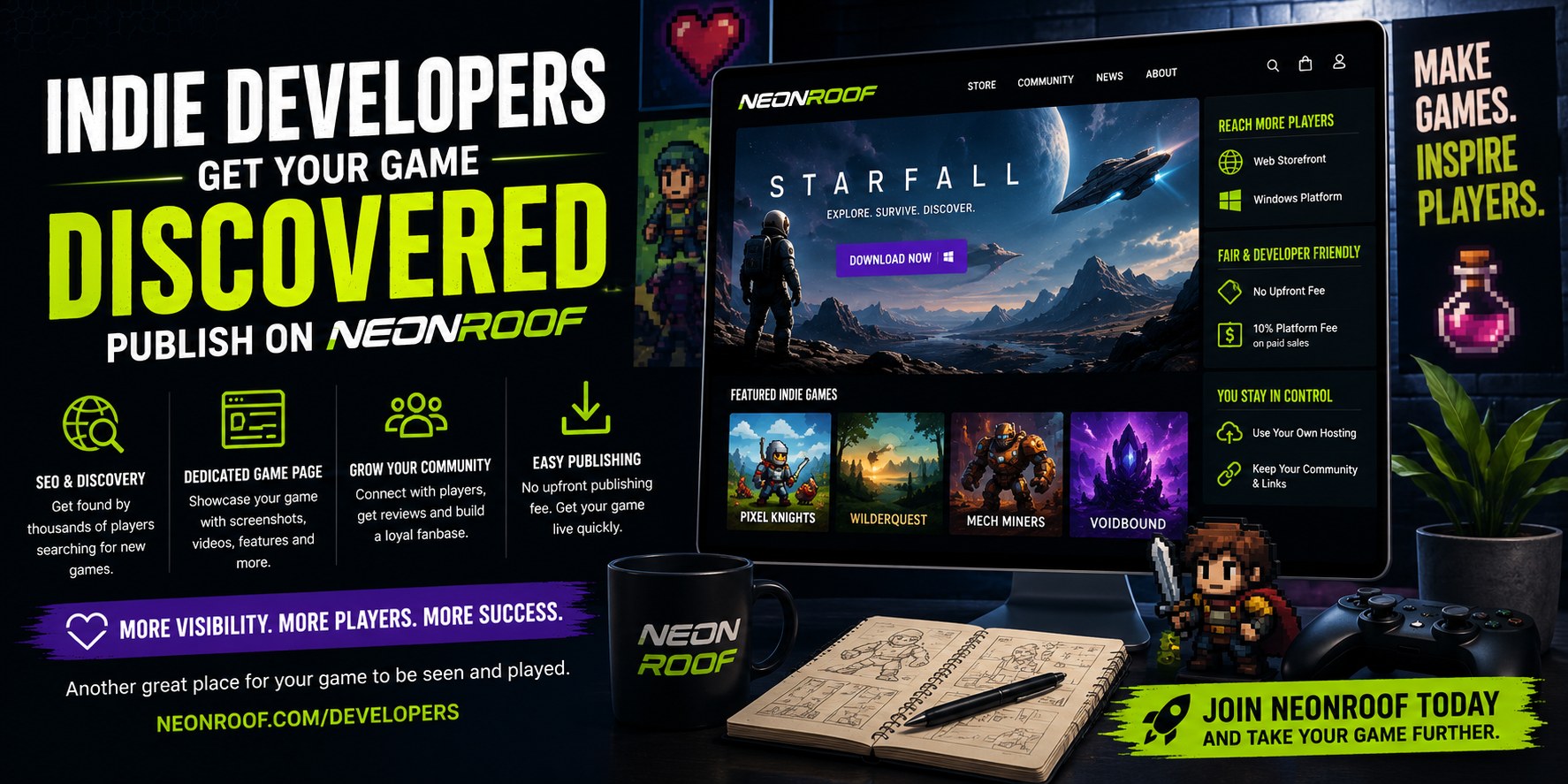
Join players and independent developers in the NeonRoof Discord community to discuss these games, publishing, and practical game-development work.
Indie game marketing does not have to begin with a large advertising budget. NeonRoof gives PC developers another way to create a searchable storefront, reach new players, build links to their website, and potentially gain additional exposure through NeonRoof News.
##
Finishing an indie game is a major accomplishment, but releasing it does not automatically mean players will find it. A developer can spend months or years programming systems, fixing bugs, creating artwork, building levels, recording a trailer, and preparing a store page, only to discover that the hardest challenge begins after launch.
That challenge is visibility.
Large publishers can spend heavily on advertising, sponsored streams, public relations, paid social campaigns, and storefront promotion. Most independent developers do not have that kind of budget. A solo developer may have spent nearly everything on development, while a small studio may need every dollar available for hosting, contractors, software, testing, and future updates.
Fortunately, promoting an indie game does not always require a large advertising budget. Developers can improve their chances of being discovered by creating more legitimate places where players, search engines, communities, and gaming publications can encounter the game.
That is one of the main ideas behind NeonRoof.
NeonRoof is being built as an additional PC gaming platform for developers who want another storefront, another searchable web page, another distribution channel, and potentially another way to gain long-term exposure through game coverage and search-focused content.
Free Indie Game Promotion Is Really About Discovery
When developers hear the word marketing, they often think immediately about advertising. Advertising is useful, but it is only one part of game promotion.
Players discover games in many different ways. Someone might find your title through Google, a YouTube video, a Discord recommendation, a genre roundup, a developer interview, a game store, a Reddit discussion, or a friend who discovered the game somewhere else.
The goal should not be to find one magical promotional channel. A better strategy is to create several legitimate paths that can eventually lead players toward your game.
That is particularly important for unknown games because players cannot search for a title they have never heard of. Your game's name may eventually become valuable in search, but early discovery often happens through broader topics such as "best indie RPG games," "free multiplayer PC games," "games for low-end PCs," or "new indie strategy games."
NeonRoof is trying to create more of those entry points.
You Do Not Have to Leave the Platforms You Already Use
Adding NeonRoof does not mean abandoning Steam, itch.io, your own website, or any other storefront that already works for your game.
In fact, keeping those existing channels is usually the better strategy.
We explored this idea in Where Should Indie Developers Publish PC Games in 2026? Why One Store Is Not Enough.
An additional storefront gives your game another place to exist without requiring you to remove it from somewhere else. Your Steam listing can keep generating sales. Your itch.io page can continue serving its community. Your website remains the online property you control. Your Discord continues connecting you directly with players.
NeonRoof simply becomes another part of that network.
For a small developer, that additional reach can matter. Even if one platform remains responsible for most of your downloads or revenue, players discovered through another source are still players you may not have reached otherwise.
Publish on NeonRoof Without an Upfront Publishing Fee
For developers trying to promote a game without a large budget, the cost of adding another storefront matters.
Developers can begin through the NeonRoof Developer Publishing page.
If you already host your game's files using your own protected storage bucket, delivery API, or supported public download location, you can use that existing infrastructure rather than paying NeonRoof for another copy of your hosting.
Optional NeonRoof-managed hosting is available for developers who prefer it, but a developer who already has a working delivery system does not need to replace it simply to create another storefront.
That makes NeonRoof particularly useful for developers looking for additional game promotion without another upfront publishing expense.
For commercial titles sold through NeonRoof checkout, the current NeonRoof platform fee is 10% on paid game sales.
A NeonRoof Listing Gives Your Game Another Searchable Web Page
A NeonRoof storefront is more than a download button.
A game page can include a detailed description, screenshots, artwork, trailers, system requirements, genres, tags, developer information, pricing, community links, support links, and download information.
That gives players a proper destination where they can understand what the game is before installing or purchasing it.
It can also create another searchable page associated with the game and developer.
Search engines need context. A page that clearly explains that a game is a multiplayer tactical shooter, a lightweight strategy game, a physics simulator, or a solo-developed RPG gives search engines more information than a page containing only a game title and a download button.
There are no guarantees in SEO, and no legitimate platform can promise that a page will rank first on Google. What you can do is create useful, descriptive, interconnected pages that give search engines and players more information to work with.
That is one of the reasons NeonRoof places so much emphasis on web storefronts rather than hiding every game exclusively inside a launcher.
Your Game Name May Not Be How Players First Find You
Imagine that you release a game called Chronicles of Nareth.
If you are a new developer, almost nobody is searching for "Chronicles of Nareth" yet. That does not mean the game cannot receive search traffic. It means the first useful keywords may describe the kind of game you created instead of its title.
Potential players might be searching for "best indie fantasy RPG games," "new PC RPGs," "games made by solo developers," "low-end PC RPG games," or "free fantasy games."
The same principle applies across genres.
A multiplayer shooter might be discovered through searches for free FPS games. A strategy game might appear in searches for civilization-style games or free RTS titles. A lightweight game might reach players searching specifically for games that can run on older PCs.
This is where editorial content becomes valuable.
NeonRoof News Adds Another Discovery Layer
The NeonRoof News section is designed to create additional ways for players to encounter games.
For example, the 6 Best Free FPS Games for PC to Play in 2026 reaches players who already know they want a shooter but may not know which individual game they want.
A reader might arrive looking broadly for a free FPS and discover OpenArena, Xonotic, Unvanquished, OpenSpades, or another title they had never searched for by name.
The same idea applies to the 9 Best Free Strategy Games for PC to Play in 2026.
Players searching for strategy games can discover specific titles through an article that answers a broader question.
This kind of content can be valuable for indie developers because it creates discovery before brand recognition exists.
One Game Can Fit Many Different Search Topics
Developers sometimes underestimate how many different topics can surround one game.
Suppose you release a multiplayer racing game. Obviously, it could appear in content about indie racing games.
But perhaps it also runs extremely well on modest hardware. Now it could be relevant to an article about the best games for low-end PCs.
Maybe you built it entirely by yourself. That creates a solo developer story.
Perhaps the game was made in Godot. That creates a technical development angle.
If it is free, it could fit into free-game recommendations. If it has unusual vehicle physics, that could justify a separate feature explaining how those systems work.
The same game can therefore have several different discovery paths without changing anything about the game itself.
The content surrounding the game changes.
Rigs of Rods Is a Good Example
Rigs of Rods demonstrates how this type of discovery can work.
Players can visit the Rigs of Rods game page on NeonRoof to learn about the game itself.
NeonRoof also published a dedicated feature, Rigs of Rods: The Open-Source Vehicle Simulator That Keeps Rolling Forward.
That article gives people another reason to encounter the project. Someone interested in soft-body physics, vehicle simulators, trucks, aviation, modding, open-source development, or long-running gaming communities could discover Rigs of Rods without originally searching for the title.
The game page serves one purpose. The article serves another.
Together, they create more ways for someone to find the same project.
That is the kind of ecosystem NeonRoof wants to build around interesting independent games.
Best of 2026 Content Can Introduce Unknown Games to Players
Recommendation articles are particularly useful because they attract readers based on an interest rather than a specific game title.
The 9 Best Free Games for Low-End PCs to Play in 2026 targets players who may simply own an older laptop or inexpensive desktop and want something enjoyable that will run well.
The 6 Best Free FPS Games for PC to Play in 2026 targets people searching specifically for shooters.
The 9 Best Free Strategy Games for PC to Play in 2026 reaches another audience.
And 7 Great Free PC Games You Can Play Right Now on NeonRoof takes a broader approach.
As NeonRoof adds more independent developers, similar articles can cover new categories such as indie horror games, solo-developed games, indie RPGs, co-op games, Godot games, multiplayer titles, racing games, and upcoming releases.
An interesting game can potentially appear in several of those categories over time.
NeonRoof Wants the Story Behind the Game
A developer can make this process much easier by providing more than a download link.
Tell people why the game exists.
Explain what makes it different from other titles in the genre. Talk about the technology behind it. Mention whether you built it alone or with a small team. Share the unusual problems you had to solve during development.
Maybe the game took five years to build.
Maybe development began as a college project.
Maybe a community helped shape an important mechanic.
Maybe you wrote your own engine.
Maybe you used Godot, Unity, Unreal, Rust, or some unusual combination of technologies.
Those details can be interesting to players and other developers.
They also create more potential topics for articles and search traffic.
A game release is one story. The developer behind the game can contain many more.
Developers Should Promote Their Own Name Too
It is easy to focus entirely on the game title, but indie developers should also think about building recognition around their studio or personal developer identity.
A successful game may eventually lead to another game.
If players remember the developer behind the project, the next release does not have to begin completely from zero.
That is why NeonRoof game pages can point toward developer websites, communities, and official resources.
If NeonRoof introduces a player to your game and that person eventually joins your Discord or follows your next project, the developer benefits beyond a single download.
This is another aspect of the discovery problem discussed in Indie Game Developers Need More Ways to Get Discovered in 2026.
The goal should be to build a network around both the game and the people who created it.
SEO and Social Media Work Better Together
Search traffic and social media traffic behave differently.
Social platforms are excellent for immediate attention. A developer can share a trailer, screenshot, GIF, update, or funny development bug and receive reactions almost immediately.
The downside is that social feeds move quickly.
A post can receive attention today and effectively disappear tomorrow.
Search-focused content can behave differently. A useful game page or article can potentially continue attracting visitors long after the original announcement was published.
That does not mean developers should choose SEO instead of social media.
Use both.
If NeonRoof publishes a feature about your game, you can share that article with your existing community. NeonRoof can share it too. Players can visit the article, click through to the game, visit the developer's website, and potentially link or share the story elsewhere.
The short-term social activity can help introduce content that may have much longer-term search value.
Backlinks Can Help Build a Larger Web Presence
Links are another important part of online discovery.
Suppose NeonRoof publishes an article about your game that links to your official website.
Some readers may click that link immediately.
That direct traffic is useful, but the broader connection matters too.
Your NeonRoof game page can link toward the developer. A News article can link toward the storefront. A recommendation article can link toward the game. Your own website can mention or link back to the coverage.
Over time, those connections create a larger collection of pages surrounding the same project.
Again, backlinks are not a guarantee of search rankings, and SEO should never be sold as magic. They are one component of a larger strategy for giving search engines and users more ways to understand and navigate your game's online presence.
Free Promotion Still Requires a Good Presentation
Publishing without an upfront fee does not mean developers can ignore presentation.
Your screenshots matter.
Your description matters.
Your trailer matters.
Your artwork matters.
If your game has something genuinely different about it, explain that clearly.
A player should not need to read ten paragraphs before understanding the basic concept.
A good storefront should quickly answer questions such as what the game is, why it is interesting, what genre it belongs to, whether the player's PC can run it, and where they can learn more.
If you want NeonRoof News or another publication to write about your project, make the story easy to understand too.
The platform can create another opportunity for discovery, but developers still need to give players a reason to care.
You Can Reach Players Through the Web and Windows
NeonRoof provides more than a web storefront.
Players can browse the NeonRoof PC Game Store through the website and use the NeonRoof Windows Platform for the desktop experience.
That creates different discovery environments around the same catalog.
One player may find your game through a Google search that leads directly to the web page.
Another may discover it while browsing inside the Windows platform.
The developer does not need to build two completely separate game listings to reach those audiences.
For a small studio, that additional reach can be useful without adding a large amount of additional publishing work.
Publishing Is Designed to Be Straightforward
If you already have a finished or playable PC game, there is a good chance you already have most of the material required for a NeonRoof storefront.
You likely have a title, description, cover artwork, screenshots, trailer, system requirements, build files, website, and community links.
Our guide How to Publish Your Indie PC Game on NeonRoof in 2026 goes through the process in more detail.
Developers can create an account, request publisher approval, choose how the build will be delivered, create the game page, and publish the title.
If the game is commercial, Stripe payout onboarding can be connected for paid sales.
You are not rebuilding the game for NeonRoof.
You are creating another place where an existing game can be found.
An Additional Platform Can Reduce Dependence on One Source
There is another practical advantage to expanding your distribution.
Relying entirely on one storefront, one social network, or one traffic source creates risk.
Algorithms change.
Policies change.
Recommendation systems change.
Search rankings change.
Platforms become more or less popular.
Developers cannot control all of those things.
Having a website, community, multiple storefronts, search content, and other discovery sources means one change is less likely to eliminate every path toward your game.
NeonRoof does not need to become your largest source of players to be useful.
It simply needs to create players, traffic, links, or opportunities you did not previously have.
The First Hundred Players Can Be Extremely Valuable
Independent developers naturally dream about large numbers, but the earliest players can sometimes be the most important.
The first hundred players may report bugs, join your Discord, leave reviews, tell friends, create screenshots, make YouTube videos, or simply help prove that a community exists around the game.
Those people can become the foundation for everything that comes later.
That is why another platform can matter even before it generates enormous numbers.
One new player can lead to another.
A small group can become a community.
A community can begin creating its own discovery.
Early Developers Have More Room to Stand Out on a Growing Platform
NeonRoof is still growing its independent developer catalog.
That creates an opportunity that naturally becomes smaller as any platform expands.
A game joining a platform with hundreds of thousands of releases can be difficult to notice.
On a growing platform, there is more room to learn who the developer is, understand the project, and potentially build editorial coverage around interesting titles.
That does not mean every game automatically receives a feature or ranking placement. Editorial coverage should still depend on whether there is something useful or interesting to tell players.
But developers joining early have an opportunity to become part of the platform while its indie catalog is still being established.
Getting Discovered Is the Bigger Goal
The underlying problem is not that indie developers lack places where files can be uploaded.
There are already many ways to host a game.
The harder problem is getting somebody who has never heard of your project to care enough to click.
That is why NeonRoof is investing in more than game hosting.
Searchable storefronts, NeonRoof News, recommendation articles, developer features, web access, Windows distribution, internal linking, and links toward developers all support the same larger goal.
Help players discover interesting PC games.
That philosophy is also behind Why Indie Developers Should Add NeonRoof to Their Game Launch Strategy in 2026, which looks more closely at how storefronts, News coverage, and search content can work together.
How to Promote Your Indie Game for Free With NeonRoof
If you are trying to figure out how to promote an indie game without a large advertising budget, adding another legitimate discovery channel is a practical place to start.
Begin with the NeonRoof Developer Publishing page and see whether NeonRoof fits your game.
If you want the practical publishing process, read How to Publish Your Indie PC Game on NeonRoof in 2026.
If you are deciding whether another storefront is worthwhile, read Where Should Indie Developers Publish PC Games in 2026? Why One Store Is Not Enough.
For a deeper look at the visibility problem itself, read Indie Game Developers Need More Ways to Get Discovered in 2026.
You can also see the type of search-focused content already being built through the 6 Best Free FPS Games for PC to Play in 2026, 9 Best Free Strategy Games for PC to Play in 2026, 9 Best Free Games for Low-End PCs to Play in 2026, and 7 Great Free PC Games You Can Play Right Now on NeonRoof.
The dedicated Rigs of Rods feature also shows how a game can receive attention beyond its basic storefront.
No platform can promise that an unknown game will suddenly become famous. What NeonRoof can offer is something more practical: another storefront, another searchable page, another audience, another potential article, another backlink, and another opportunity for somebody to find the game.
If you already put months or years into creating your project, giving it another legitimate place to be discovered is a relatively small additional step.
For developers using their own supported delivery infrastructure, that step can begin without an upfront publishing fee.
Practical developer publishing library
Plan the release with the complete 90-day indie launch checklist and prepare outreach with How to Make an Indie Game Press Kit Journalists Can Actually Use.
Turn discovery into a sustainable process
Connect content, community, demos, and measurement with How to Market an Indie Game Organically in 2026.
Free tools for building and publishing an indie game
Continue with the NeonRoof software collection to turn an idea into game assets, marketing material, and a public game page ready for players.
No comments yet. Start the conversation with a useful, on-topic response.