Join players and independent developers in the NeonRoof Discord community to discuss these games, publishing, and practical game-development work.
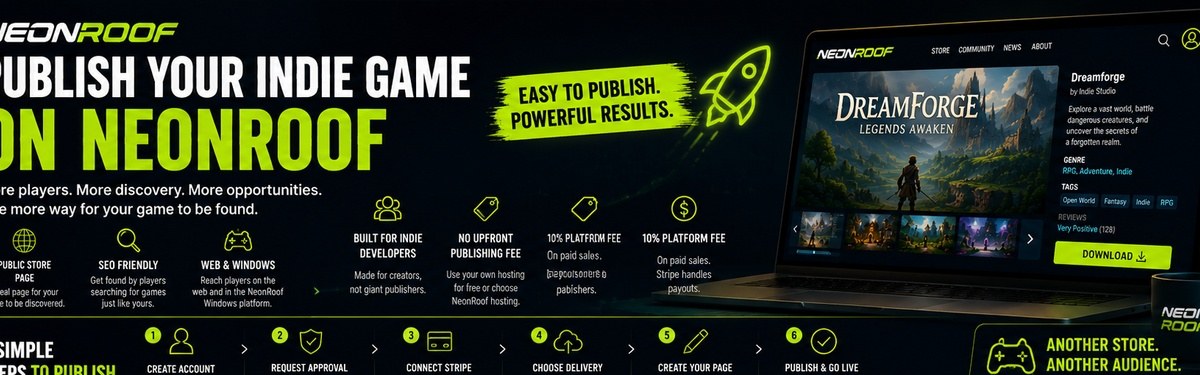
Adding another storefront does not have to mean rebuilding your launch strategy. NeonRoof gives indie developers a simple way to create a public game page, reach players on the web and Windows, use their own hosting if they want, and publish without an upfront listing fee.
##
You already built the game.
You already created the screenshots.
You probably already have a trailer.
You may already have a website, Steam page, itch.io listing or Discord community.
So why should adding another platform require starting everything over again?
It should not.
One of the biggest ideas behind NeonRoof is that independent developers should be able to add another legitimate distribution and discovery channel without turning it into another enormous development project.
You should not have to abandon the stores you already use.
You should not have to move your community.
You should not have to rebuild your entire infrastructure.
And if you already host your own game files, you should not have to pay NeonRoof just to duplicate that hosting.
Instead, NeonRoof can become another place where your game exists.
Another storefront.
Another searchable webpage.
Another Windows gaming platform.
Another place for players to find your studio.
And potentially another path into NeonRoof News, genre roundups and other content designed to help players discover games they may never have searched for by name.
We have already discussed why indie game developers need more ways to get discovered in 2026.
We have also looked at why indie developers should publish their PC games on more than one storefront.
Now let's talk about the practical part.
How difficult is it actually to put your game on NeonRoof?
The answer is pretty straightforward.
NeonRoof Is Designed to Be an Additional Platform
This is probably the most important thing for developers to understand.
NeonRoof does not require your game to become exclusive.
If Steam is working for you, keep Steam.
If itch.io works for you, keep itch.io.
Keep selling directly from your website if that works.
Keep your Discord community.
Keep your mailing list.
Keep everything that is already helping your game.
NeonRoof is another door.
That is the whole point.
A player might discover your game through Steam.
Another might find your website through Google.
Another could see it in a NeonRoof News article.
Another might find your NeonRoof storefront after searching for a specific genre.
Another may discover it while browsing the NeonRoof Windows platform.
Those players do not have to come from the same place.
For a small development team, every legitimate discovery path matters.
Publishing Starts With a NeonRoof Developer Account
The process begins through the NeonRoof Developer Publishing page.
Create a NeonRoof account and begin developer onboarding.
That same account is used across the NeonRoof ecosystem, including the website and Windows platform.
Developers can then use Game Studio in the NeonRoof Windows application to begin setting up their publishing account and game storefront.
There is no need to create one identity for the website, another for the launcher and another for publishing.
The goal is to keep the process connected.
The Publishing Process Is Six Basic Steps
NeonRoof currently breaks publishing into a simple workflow:
- Create and verify your NeonRoof account. This becomes the account you use for the website, launcher and developer tools.
- Request publisher approval. Open Game Studio in the NeonRoof Windows platform and submit the publisher verification request.
- Connect Stripe if you are selling a paid game. Paid titles require payout onboarding so your developer share can be sent to your connected Stripe account.
- Choose how your game will be delivered. Use your own protected storage bucket, delivery API or supported public URL, or choose optional NeonRoof hosting.
- Create and validate your game listing. Add the artwork, description, screenshots, trailer, requirements, download information and other storefront details.
- Publish the game. Once approved and validated, the same catalog entry can appear on the NeonRoof website and Windows platform.
That is the core process.
You are not integrating an SDK just to create a basic game listing.
You are not rebuilding your game around NeonRoof.
You are giving an existing PC game another place to be discovered and downloaded.
You Can Use Your Own Hosting for Free
This is one of the most useful NeonRoof features for indie developers who already have distribution infrastructure.
Suppose your game builds are already stored in:
Amazon S3,
Cloudflare R2,
Azure Blob Storage,
Backblaze,
your own server,
or another protected storage system.
You do not necessarily need to move those files.
NeonRoof supports developer-owned protected storage buckets and delivery APIs without charging an additional NeonRoof hosting fee.
Supported public download URLs can also be used when appropriate.
That means the game can have a NeonRoof storefront while you remain in control of the actual build delivery.
If you already have a system that works, keep using it.
That dramatically lowers the friction involved in adding another storefront.
Developers who do not want to manage their own storage can also use optional NeonRoof-hosted storage.
The important part is having a choice.
No Upfront Publishing Fee for Developer-Owned Delivery
Small developers are already dealing with enough expenses.
Art.
Music.
Software.
Hosting.
Contractors.
Testing.
Hardware.
Business registration.
Marketing.
Maybe several years of unpaid development time.
Paying another large fee just to see whether a storefront produces any players can make expansion difficult.
With NeonRoof's developer-owned delivery options, there is no upfront publishing fee simply to list and deliver your game using your own infrastructure.
That makes experimenting with NeonRoof considerably easier.
You can create another storefront and see what kind of audience it develops without making another large upfront commitment.
For a developer trying to grow recognition, that is important.
Paid Games Currently Use a 10% NeonRoof Platform Fee
If you sell a paid game using NeonRoof checkout, NeonRoof currently uses a 10% platform fee on completed paid game sales.
Stripe handles developer payout onboarding.
That means developers connect their payout information using Stripe rather than giving NeonRoof direct access to bank account or routing information.
For developers, the idea is straightforward.
You publish the game.
A player buys it.
NeonRoof keeps its platform fee.
The developer's share is routed through the connected payout system.
Developers remain free to continue selling through other stores at the same time.
Your Game Gets a Real Public Storefront
This is where NeonRoof becomes more than another download button.
A game listing can become a full public page containing information players and search engines can actually use.
Look at the 0 A.D. storefront on NeonRoof.
That page includes:
game artwork,
a detailed description,
genre information,
screenshots,
system requirements,
developer information,
community links,
a trailer,
download information,
related games,
and other discovery features.
The OpenArena NeonRoof page follows the same general idea for a completely different kind of game.
OpenArena is an arena shooter.
0 A.D. is a historical RTS.
The structure works for both because the storefront is built around giving players enough information to understand the game before downloading it.
You can see another example with SuperTuxKart on NeonRoof, which combines screenshots, game information, developer links, community options and related-game discovery around an arcade racing title.
Or look at OpenHV on NeonRoof, where a smaller science-fiction RTS gets its own standalone page rather than disappearing inside a giant anonymous list.
That is what we want indie developers to have.
A real destination for the game.
Your NeonRoof Page Can Help Your Existing Website
An additional storefront should not isolate your game from the rest of your online presence.
It should connect to it.
A NeonRoof game page can link players toward the developer's website, support pages and community resources.
That means a player can discover your game on NeonRoof and continue toward the online presence you already built.
That matters for SEO too.
Your developer website should remain an important part of your strategy.
Your NeonRoof page becomes another page associated with your game and studio.
NeonRoof News coverage can become another.
Your existing storefronts become others.
Those pages start forming a network around your title.
We explained that idea in more depth in Indie Game Developers Need More Ways to Get Discovered in 2026.
The goal is not one giant page that somehow performs every marketing job.
The goal is multiple useful pages giving players multiple ways to find you.
The Same Game Can Reach Web and Windows Players
NeonRoof is not only a web store.
The NeonRoof Windows Platform provides the desktop side of the ecosystem.
Players can browse games, maintain libraries, interact with community features and access titles through the Windows experience.
From the developer side, the important idea is that you are not creating two completely unrelated product listings.
The catalog connects the web storefront and Windows platform.
That gives the game two discovery environments.
A player searching Google may land directly on your web storefront.
Someone already browsing NeonRoof from Windows may encounter the game through the platform.
One listing can therefore serve different types of users.
Players Can Also Download From the Web
A desktop launcher can be useful.
Requiring every player to install one before they can even interact with a game can create friction.
NeonRoof's web storefront also supports player libraries and web downloads for supported games.
That means players can discover a game through search or NeonRoof News, visit the game page and interact with the storefront from the browser.
Players who prefer the launcher can use the Windows platform.
Again, the idea is choice.
Developers get another distribution environment.
Players get multiple ways to use it.
NeonRoof News Can Turn a Store Listing Into a Story
This is probably the part of NeonRoof that has the most potential for indie developers.
A storefront explains what your game is.
A news article can explain why somebody should care.
Those are two different jobs.
Suppose you created an unusual indie RPG.
Your store listing can show:
the trailer,
screenshots,
features,
requirements,
price,
and download button.
But there may be another story.
Maybe you built the game alone.
Maybe you wrote your own engine.
Maybe you spent six years developing it.
Maybe the entire game began as a university project.
Maybe a Discord community helped design the combat system.
Maybe you built an unusual multiplayer architecture.
Maybe you used Godot and Rust.
Maybe you created every piece of artwork yourself.
That is something NeonRoof News can talk about.
The developer becomes part of the story rather than disappearing behind the product.
NeonRoof Is Already Building Content Around Games
This is not simply an idea for the future.
NeonRoof News already publishes content designed around game discovery.
Players looking for shooters can find the 6 Best Free FPS Games for PC to Play in 2026.
Strategy players can find the 9 Best Free Strategy Games for PC to Play in 2026.
Players with modest computers can find the 9 Best Free Games for Low-End PCs to Play in 2026.
And players looking for a broader collection can explore 7 Great Free PC Games You Can Play Right Now on NeonRoof.
Those articles do something a storefront alone cannot.
They answer searches based on what players want.
A gamer may never type your game's title into Google.
They cannot.
They have never heard of it.
But they might search:
best indie RPG games
or:
free multiplayer PC games
or:
best games for low-end laptops
or:
new indie strategy games
That is the moment your game has an opportunity to be introduced.
You Do Not Need to Choose Between NeonRoof and Your Existing Store
We covered this question extensively in Where Should Indie Developers Publish PC Games in 2026? Why One Store Is Not Enough.
But it is worth repeating because developers sometimes think of stores as an either-or decision.
They do not have to be.
If another storefront is producing sales, keep it.
If itch.io is producing downloads, keep it.
If your own website is working, keep it.
Adding NeonRoof does not mean deleting any of them.
The value is incremental reach.
If one platform sends you 1,000 players and another sends you 100 players, those 100 players still matter.
If five of them become active community members, they matter even more.
If one creates a YouTube video about the game, that can create another discovery path.
Growth can start with surprisingly small numbers.
Additional Platforms Reduce Dependence
There is another reason developers should consider multiple distribution channels.
Dependence creates risk.
If almost every sale, player and review comes from one platform, changes to that platform can have an enormous effect on your business.
An algorithm changes.
Your visibility drops.
A recommendation system changes.
Your traffic changes.
A policy changes.
Your costs change.
None of that means large stores are bad.
It means independent businesses should avoid depending completely on a single source whenever practical.
Another storefront creates another audience.
Your own website creates another.
Search traffic creates another.
Community creates another.
Direct email creates another.
NeonRoof can become one more piece of that larger strategy.
Early NeonRoof Developers Have More Room to Stand Out
There is a huge difference between joining a catalog while it is growing and entering one containing hundreds of thousands of products.
Smaller platforms have fewer games competing for every inch of attention.
That gives early developers a unique opportunity.
NeonRoof is actively looking for independent games.
Interesting games can be noticed.
Interesting developers can be contacted.
Interesting development stories can become articles.
Interesting projects can be included in future roundups and discovery content.
That does not guarantee traffic or rankings.
Nothing legitimate does.
But being one of the first developers on a growing platform is very different from being title number 200,000 in a mature catalog.
Free Games Can Benefit Too
NeonRoof is not only for paid commercial releases.
Free games can use the platform as another way to build a community.
For a new developer, sometimes the most important numbers are not dollars.
They are:
downloads,
players,
reviews,
community members,
feedback,
Discord joins,
website visits,
and people who remember the studio name.
A free game can be the beginning of a development career.
The developer who releases a free project today may release a $20 commercial game two years from now.
Building the audience early matters.
Open-Source Projects Have a Place Too
The current NeonRoof catalog also contains community-developed and open-source projects.
That includes games such as 0 A.D., OpenArena, SuperTuxKart and OpenHV.
These projects demonstrate something important.
The goal is not only selling products.
It is game discovery.
A free or open-source game can benefit from:
more players,
more contributors,
more community activity,
more website traffic,
more documentation visibility,
and more people simply knowing the project exists.
A strong PC gaming ecosystem should have room for commercial developers and community projects.
You Control How Much NeonRoof Does
Some developers want a platform to handle everything.
Others already have infrastructure.
NeonRoof's publishing model is intentionally flexible.
If you already have protected delivery infrastructure, use it.
If you want NeonRoof to host the game, there is an optional hosting path.
If your game is free, publish it as free.
If it is commercial, sell it.
If you already have your own community, link to it.
If you have a support website, link to it.
The platform should adapt around the developer rather than forcing every studio into exactly the same setup.
What Should You Prepare Before Publishing?
You probably already have most of what you need.
Prepare a polished game title and description.
Have good cover artwork and wide hero artwork ready.
Collect several strong screenshots.
Have a trailer if one exists.
Know your genre and relevant tags.
Document your minimum and recommended system requirements.
Decide how players will download the game.
Have your official website, community and support links available.
If you are selling the game, be prepared to complete Stripe payout onboarding.
Then create the storefront.
None of that should be unfamiliar to a developer who has already prepared a game for release elsewhere.
That is exactly the point.
NeonRoof should be an additional distribution path, not another development project.
The Hard Part Was Making the Game
Think about what you already accomplished.
You created the concept.
Built prototypes.
Wrote code.
Created assets.
Fixed bugs.
Designed menus.
Built levels.
Balanced gameplay.
Tested builds.
Created screenshots.
Made trailers.
Built a website.
Maybe spent years doing it.
Compared with all of that, creating another storefront should be easy.
And when another storefront does not require a large upfront publishing fee, the question becomes less:
Why should I publish there?
and more:
Why would I unnecessarily give my game one fewer chance to be discovered?
NeonRoof Is Another Chance
That is the simplest way to explain it.
NeonRoof is another chance.
Another player can find you.
Another search result can mention you.
Another article can link to you.
Another storefront can sell the game.
Another community member can join.
Another person can recommend it.
Another streamer can discover it.
Another developer can see what you built.
One additional discovery channel will not magically solve indie game marketing.
But independent developers rarely succeed because of one magical thing.
Success is usually cumulative.
One player.
Then ten.
Then one hundred.
One article.
Then another.
One search result.
Then several.
One storefront.
Then another.
The footprint gets larger.
Start Publishing on NeonRoof
If you already have a finished or playable PC game, adding NeonRoof can be surprisingly straightforward.
Start on the NeonRoof Developer Publishing page.
Create your developer account.
Download the NeonRoof Windows Platform and continue through Game Studio.
Choose your delivery method.
Build the storefront.
Publish your title.
Then give players one more way to discover what you spent so much time creating.
You can browse the NeonRoof PC Game Store to see the growing catalog.
Take a look at 0 A.D., OpenArena, SuperTuxKart and OpenHV to see examples of how very different types of games can have full NeonRoof storefronts.
Then read the other two parts of our indie developer series:
Indie Game Developers Need More Ways to Get Discovered in 2026
and
Where Should Indie Developers Publish PC Games in 2026? Why One Store Is Not Enough.
Those articles explain why additional discovery matters.
This one explains how easy it can be to actually start doing something about it.
You already made the game.
Now give it another place to be found.
A practical next step for indie developers
Before choosing another publishing channel, prepare a reproducible build and a player-focused store page. Compare the description, media, support details and release timing against the materials you already use on other stores.
Check your description, artwork dimensions, sales assumptions and release timing with the free Indie Dev Tools hub. These checks help you prepare a clearer launch; they do not predict search rankings or guarantee sales.
If you want help creating the NeonRoof listing, use free assisted game publishing. Send a supported build or download URL, artwork, gameplay screenshots, a trailer when available, contact details and the required rights and identity verification. Paid games also require payout onboarding.
Practical developer publishing library
Plan the release with the complete 90-day indie launch checklist and prepare outreach with How to Make an Indie Game Press Kit Journalists Can Actually Use.
Turn discovery into a sustainable process
Connect content, community, demos, and measurement with How to Market an Indie Game Organically in 2026.
Free tools for building and publishing an indie game
Continue with the NeonRoof software collection to turn an idea into game assets, marketing material, and a public game page ready for players.
- Best Free Game Development Software for Indie Developers in 2026
- Indie Game Art and Trailer Workflow With Blender, GIMP, and HandBrake
- The Indie Game Development Toolchain: From Prototype to Players
Related practical guides for indie developers
If you want NeonRoof to prepare the listing, gather your build, media and verification with this submission guide: What to Send NeonRoof for Free Assisted Indie Game Publishing.
No comments yet. Start the conversation with a useful, on-topic response.